Affluent Flyers: Secure Private Jet Priority With Bluebird's $3,995

Affluent Flyers: Secure Private Jet Priority With Bluebird’s $3,995
The fastest routes to priority private jet booking are membership or jet-card programs with guaranteed availability, paired with concierge-managed bookings for time-sensitive trips. If your dates are fixed, book a standard charter now. If they’re flexible, set live alerts, subscribe to a priority program, and be ready to confirm within hours when a match appears.
TL;DR:
- Memberships with empty-leg access are most cost-effective for travelers flying more than eight times a year and with flexible dates, offering priority and discounts.
- Guaranteed-availability jet cards suit those with fixed schedules and minimal date flexibility, providing prompt booking within hours for predictable trips.
- Speed and responsiveness are crucial; responding within an hour to alerts or offers significantly increases chances of securing preferred flights.
- Booking should include detailed verification of operator safety standards, cancellation policies, and written recovery plans to avoid unexpected issues.
- For fixed, high-stakes trips, concierge-managed bookings with a personal advisor still offer the highest certainty, especially when combined with earlier booking windows.
Table of Contents
- What Are the Main Priority Booking Options?
- How Do You Actually Book a Priority Private Jet Flight?
- When Should You Book for the Best Availability?
- Which Tactics Actually Improve Your Odds?
- How Does Bluebird’s Membership Put These Tactics Into Practice?
- What Should You Check Before Signing a Priority Booking Agreement?
- What I’d Prioritize If I Only Had Time for One Thing
- How Bluebird Membership Turns Priority Access Into a Real Seat
- Sources
- FAQ
What Are the Main Priority Booking Options?
Not every priority path fits every flying pattern. Someone who flies twice a year on fixed dates needs something different from someone who wants a jet whenever a good empty leg surfaces. Here’s how the four main tracks actually work.
Memberships built around empty-leg access. These subscription models give you earlier visibility into empty-leg inventory, plus queue placement when multiple members want the same seat. The trade-off is straightforward: you pay an annual fee for the visibility and priority, in exchange for flights that are often deeply discounted or free relative to a private charter booked from scratch. You’re not guaranteed a specific date, but you’re first in line when the right flight appears.
Jet cards and guaranteed-availability products. These work on prepaid flight hours and typically promise a fixed notice window, sometimes as tight as a few hours during peak periods. Jet card programs commonly advertise guaranteed availability as their central selling point, which makes sense for someone who flies on a predictable schedule and can’t risk being told no.
Waitlists and queue systems. Most priority queues run on a timestamp basis. Reporting on membership platforms like Vaunt shows that paid priority upgrades advance your spot on a waitlist, but the underlying order is still processed by when you acted, not just what you paid. Upgrades are often limited to once a year, so timing when you use one matters.
Concierge-managed bookings. A dedicated advisor does more than search inventory. When a trip falls through or an operator cancels, a good advisor already has a backup plan and can negotiate directly with operators to recover your seat. This matters most for trips where failure isn’t an option, a wedding, a closing, a board meeting.
So which one is right for you? A few decision rules help:
- If you fly private more than six or eight times a year, a membership or jet card typically pays for itself in savings and priority combined.
- If your travel dates are locked months out, a guaranteed-availability jet card beats chasing empty legs.
- If you can shift departure by even a day or two, membership-based priority access becomes far more valuable, since it opens up inventory you’d otherwise never see.
- If you need absolute certainty for a single high-stakes trip, pay for concierge-managed booking with a named advisor rather than relying on a queue alone.
Understanding the different types of private aviation access before you commit to one model saves you from paying for guarantees you don’t need, or worse, betting a fixed date on a system built for flexible flyers.
How Do You Actually Book a Priority Private Jet Flight?
Booking priority access moves fast once you know what to have ready. Here’s the sequence that gets you from “I need to fly” to wheels up with the least friction.
- Gather your trip details first. Departure and arrival airports, passenger count, luggage needs, and, critically, your flexibility window. A one-day shift in either direction dramatically widens your options.
- Contact your advisor or platform with a flexibility range, not a single date. Advisors and queue systems both work faster when they have room to match you against multiple aircraft, not one exact slot.
- Let the advisor confirm availability with the operator. This is where paperwork and payment typically enter the picture. Most operators want a signed agreement and deposit before they’ll hold a tail number for you.
- Understand how your request gets logged. Priority requests are generally processed in the order received. A same-day request competes differently than one submitted a week out.
- Verify terms before you pay. Confirm the departure window, the cancellation and recovery terms if the operator pulls the aircraft, and that the operator and crew meet recognized safety standards. Organizations like The Air Charter Association publish the vetting standards reputable operators are held to, and it’s worth asking your advisor to confirm the operator meets them.
Pro Tip: Ask your advisor for the exact cutoff time they need a decision by, then set a personal alarm for ten minutes before it. Priority seats on popular routes often go to whoever confirms first, not whoever asked first.
Before you finish, run through a short checklist: dates confirmed, passenger manifest sent, payment terms in writing, cancellation policy read (not skimmed), and operator safety documentation requested. That last step takes two minutes and it’s the one people skip when they’re rushing.
When Should You Book for the Best Availability?
Timing changes everything about which priority strategy makes sense. Two windows matter, and they pull in opposite directions.
The 1 to 2 month window is when you get the widest selection of aircraft types, cabin configurations, and preferred departure times. Booking a private jet one to two months out consistently gives you more choice than waiting, especially around holidays when supply tightens fast.
The 72 to 120 hour window is where empty-leg opportunities actually surface. These flights exist because an aircraft needs to reposition after dropping off a previous passenger, and empty-leg pricing often drops hardest inside 72 hours of departure as operators try to avoid flying an empty cabin at a loss.

That creates a real tension. Peak weeks, Thanksgiving, the week between Christmas and New Year’s, major sporting events, compress available inventory across every booking method. Priority membership programs tend to hold up better during these windows because members get first look at whatever repositioning flights exist, while walk-up charter requests often find nothing left.
A few patterns worth knowing:
- Empty legs cluster around major event cities in the days following the event, when aircraft need to fly back empty.
- Narrow departure windows are the norm for empty legs. You’re rarely picking your ideal takeoff time.
- Last-minute price drops on empty legs can be steep, but they require you to move fast and flexibly.
- Standard charters booked well ahead remain the more predictable option when your date can’t move.
The smartest approach for most flexible flyers is a blend: lock in a standard charter for the leg you absolutely cannot move, then run alerts against your platform’s empty-leg inventory for the flexible leg. Empty legs suit flexible schedules precisely because they reward people who can say yes on short notice, not people locked into a specific Tuesday at 9 AM.
Which Tactics Actually Improve Your Odds?
Some of these tactics matter more than others, and ranking them by impact saves you from wasting effort on the wrong lever first.
-
Turn on real-time alerts and treat every one as actionable. This is the single biggest lever available to flexible flyers. Priority queues typically process by timestamp, meaning the member who responds in minutes beats the member who responds the next morning, even if that second member technically requested priority first. Alerts you ignore are worthless; alerts you act on within the hour are how empty legs actually get booked.
-
Widen your date and airport radius. A traveler who can depart from either of two nearby airports, or shift by a day in either direction, sees dramatically more matches than someone locked to one airport and one date. Route flexibility on private jets isn’t a minor convenience, it roughly doubles or triples your effective inventory on many routes.
-
Buy a priority or skip-the-line upgrade when the trip actually matters. Timestamp-first systems reward speed, but paid upgrades exist specifically to jump you ahead of members who registered earlier but didn’t pay for priority. Understand the rule before you buy: an upgrade typically improves your position relative to other members, it doesn’t manufacture inventory that doesn’t exist.
-
Keep a named advisor and get recovery protocols in writing. Operators cancel. Weather grounds aircraft. Mechanical issues happen. The value of a concierge relationship shows up exactly when things go wrong, not when everything goes smoothly. Ask your advisor upfront: “If this aircraft falls through the night before, what’s the backup plan, and is it in writing?”
-
Match your commitment level to your flying pattern. Frequent, flexible flyers get the most value from membership-style priority access. Frequent flyers with fixed, recurring dates get more value from guaranteed-availability jet cards. Occasional flyers with one important trip a year are often better served paying for a single concierge-managed charter than committing to any annual program.
-
Blend approaches when your calendar demands it. Plenty of frequent flyers run a jet card for board meetings and quarterly trips while also carrying an empty-leg membership for weekend getaways and opportunistic travel. There’s no rule that says you can only use one system.
-
Get every fee and cancellation term in writing before you pay. This sounds obvious and it’s the step most commonly skipped under time pressure. Ask specifically about repositioning fees, deicing charges, overnight crew costs, and what happens to your deposit if the operator, not you, cancels.
Pro Tip: If you’re deciding between two similar aircraft options and one platform shows a clear queue position while the other is opaque about ordering, take the transparent one. Knowing exactly where you stand lets you make a faster go/no-go decision, which is often worth more than a marginally lower price.
The pattern across all of this: successful private jet flyers over-index on speed and flexibility, and under-index on hunting for the absolute lowest price. A seat you can actually get beats a theoretical discount you never see.
How Does Bluebird’s Membership Put These Tactics Into Practice?
Everything above is theory until you can point to how it plays out on an actual platform. Bluebird’s membership is built directly around the priority mechanics this article covers.
Members get unlimited access to empty-leg flights on Bluebird’s own fleet of Learjet 60 aircraft, with live inventory updated daily so you’re seeing repositioning flights as they open up, not days later through a broker. The Base plan runs $3,995 per year, and the Plus plan runs $9,995 per year, each granting access to the queue and priority booking system described earlier in this article. Members can bring up to six guests per flight, which changes the math considerably if you’re regularly traveling with family or a group.
For trips where waiting in the standard queue isn’t an option, the Skip-The-Line upsell costs $2,000 per flight, a direct application of the paid-priority-upgrade tactic covered above. Bluebird’s own guides on private aviation booking best practices walk through exactly how members should structure flexibility windows and airport radius to maximize matches, the same logic behind the tactics ranked in the previous section.
None of this changes physics. Empty legs still exist because of repositioning, not because a platform manufactured extra flights. A membership sharpens your visibility and improves your place in line. It does not guarantee a seat on a specific date if nothing is repositioning that way that week. For a fixed, must-make date, a standard charter still beats chasing an empty leg. For flexible, frequent flyers, membership is where the real value shows up.
What Should You Check Before Signing a Priority Booking Agreement?
Priority booking agreements, whether a membership contract, a jet card, or a concierge retainer, are legal commitments with real financial exposure, and they deserve the same scrutiny you’d give any annual contract.
Read the cancellation and refund language closely. Annual memberships and prepaid jet cards typically specify whether unused hours or access roll over, expire, or get refunded on a prorated basis if you cancel mid-term. Ask what happens if the operator, not you, cancels a confirmed flight, and get the recovery obligation in writing rather than taking a verbal assurance.
Check how “guaranteed availability” is actually defined in the contract. Some programs guarantee a notice window (say, ten hours) but not a specific date or aircraft type, which matters if you’re assuming a broader guarantee than the fine print supports. Priority upgrade fees, like skip-the-line charges, should be clearly itemized as one-time or recurring, with no ambiguity about whether they renew automatically.
Confirm liability and insurance language, particularly who is responsible if a flight is delayed, diverted, or canceled due to weather or mechanical issues outside anyone’s control. Finally, verify the operator’s certification and safety documentation independently rather than taking a platform’s word for it. These are legal documents, and reading them fully before signing is the cheapest insurance you’ll buy all year.
What I’d Prioritize If I Only Had Time for One Thing
If you take one piece of advice from this entire article, make it this: speed of response matters more than almost anything else in priority booking. Most queue systems, membership platforms, and empty-leg alerts reward the member who confirms fastest, not the member who signed up first or paid the most. I’ve looked at enough of these systems to say the pattern holds regardless of which program you’re using.
The traveler who wins the good seats isn’t necessarily the one with the most expensive membership tier. It’s the one who has alerts turned on, checks their phone, and can say yes within the hour. If you value your time more than you value shaving a few hundred dollars off a fare, build your entire strategy around responsiveness first and everything else second.
— Nick
How Bluebird Membership Turns Priority Access Into a Real Seat
Bluebird is the direct route to the priority access this entire article has been describing. Members see live empty-leg inventory as it updates daily, hold a place in the queue and priority booking system, and can layer on the Skip-The-Line upgrade for the flights that matter most.
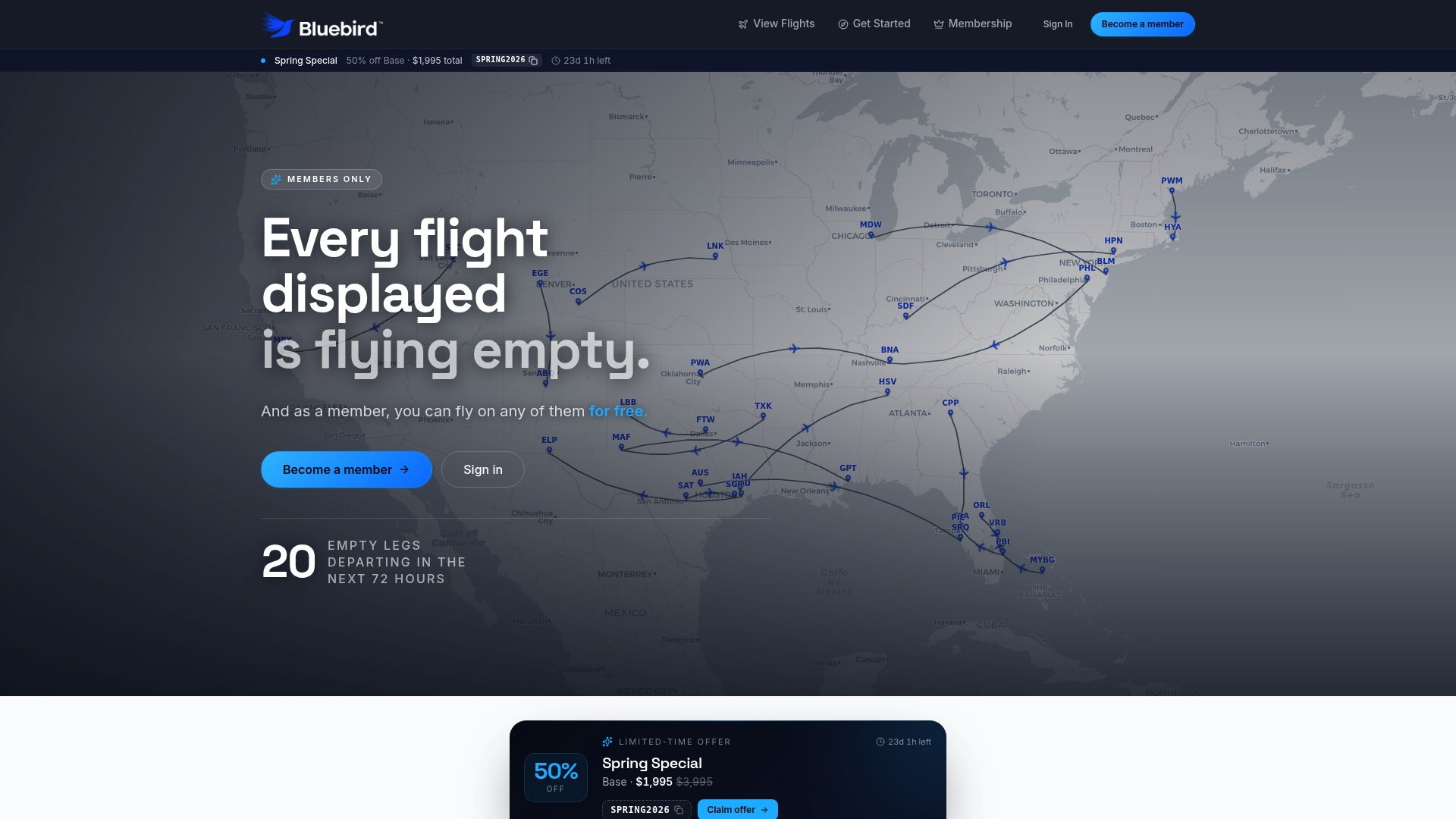
This fits best if you fly private several times a year but can’t commit to a fixed schedule, the frequent, flexible traveler who’d rather have first look at tonight’s empty leg than wait on a broker to call back. Bring up to six guests, work with concierge support when a trip needs a fallback plan, and choose between the Base plan at $3,995 per year or Plus at $9,995 per year depending on how much priority you want built in.
If a specific date is non-negotiable, a standard charter is still the safer call. But if flexibility works for you, the next step is simple: get started with Bluebird and start watching live inventory today.
Sources
- Using Vaunt: How to catch empty-leg chartered flights for cheap
- The best time to book a Private Jet + Last Minute Private Jets
- The Air Charter Association
- Empty Leg Flights: Costs and How to Book One | Peak Aviation
FAQ
How Much Does a Two-Hour Private Jet Flight Cost?
Private charter costs vary widely by aircraft category, but a two-hour flight on a light or midsize jet typically runs into the thousands of dollars depending on the operator and route. Empty-leg flights on the same routes are often available at a steep discount because the aircraft is repositioning regardless of whether it carries passengers.
Are Empty-Leg Flight Videos and Deals Shown Online Real?
Legitimate empty-leg flights are real and driven by actual aircraft repositioning needs, though the eye-catching prices shown in social videos are usually best-case examples, not typical fares. Always verify the flight, operator, and price directly through a platform or advisor rather than trusting a video alone.
Can You Write Off 100% of a Private Jet Purchase?
Tax treatment for private jet purchases and usage depends heavily on business use percentage, depreciation rules, and your individual tax situation, so there’s no universal yes or no answer. Speak with a qualified tax professional before assuming any deduction applies to your circumstances.
How Much Does a Bluebird Membership Cost?
Bluebird offers two membership tiers: the Base plan at $3,995 per year and the Plus plan at $9,995 per year, both granting unlimited access to empty-leg flights and priority queue placement. Members who want additional priority on a specific flight can also add the Skip-The-Line upgrade for $2,000 per flight.
Is a Membership Better Than a Jet Card for Priority Booking?
It depends on your flying pattern: memberships suit flexible, frequent flyers chasing empty-leg availability, while jet cards suit travelers who need guaranteed availability on fixed, recurring dates. Many frequent flyers use both, running a jet card for scheduled trips and a membership for spontaneous, flexible travel.