What Is a Travel-First Lifestyle? Your Starter Plan

A travel-first lifestyle means structuring your work, finances, and housing around the ability to move freely, treating travel as a core priority rather than an occasional reward. It fits remote workers, freelancers, location-independent entrepreneurs, and anyone willing to redesign their daily life around mobility and experience over a fixed address.
Quick-start checklist:
Audit your job for remote flexibility (or identify a skill you can freelance)
Build a 1–2 month cash buffer before your first extended trip
Book a 2–4 week test trip while working remotely to validate the model
Downsize possessions to carry-on-only or a small storage unit
Set up a virtual mailbox and a multi-currency bank account
Pro Tip: Don’t quit your job first. The safest entry point is a negotiated remote arrangement or a part-time freelance income running alongside your current role. Test the logistics before you commit to anything permanent.
Research backs the appeal. Leisure travel frequency is associated with higher quality of life through mediators like happiness and psychological resilience, with the strongest effects for people who report lower baseline coping ability. That’s not a coincidence — travel restructures how you spend time, who you meet, and what you pay attention to.
For spontaneous frequent flyers who want to move fast without commercial-flight friction, a membership like Bluebirdjets gives unlimited access to published empty-leg flights on Learjet 60 jets, with the ability to bring up to six guests per flight. More on that in the tools section below.
Key Takeaways
A travel-first lifestyle works best when it’s built in stages: test the model before you commit, build income stability before you move, and design travel around purposeful activity to maximize the wellbeing benefits the research supports.
Point | Details |
|---|---|
Definition and fit | A travel-first lifestyle prioritizes mobility over a fixed address; it suits remote workers, freelancers, and flexible earners willing to redesign their finances and housing. |
Wellbeing benefits are real | Mood benefits from travel can remain elevated for at least 21 days after returning; eudaimonic, activity-rich travel produces the longest-lasting effects. |
Stage the transition | A 30/90/365-day plan reduces risk: test remote work first, build income to 50% freelance coverage by 90 days, then optimize housing and tax logistics at 365 days. |
Logistics are learnable | Virtual mailboxes, travel health insurance, eSIMs, and monthly rentals are the four infrastructure pieces that make continuous travel sustainable. |
Bluebirdjets for frequent flyers | Members get unlimited access to empty-leg Learjet 60 flights, priority booking, and guest access, making it a strong fit for spontaneous, high-frequency travelers. |
Table of Contents
Why do people choose a travel-first life?
The benefits are real, and the research is specific enough to be useful.
A review covered by New Scientist found that mood benefits from travel begin before departure, during the anticipation phase, and can remain elevated for at least 21 days after returning. Eudaimonic activities — learning something new, connecting with locals, mastering a skill on the road — produced effects lasting up to eight weeks in some samples. That’s not a short-term mood bump; it’s a structural shift in how you experience time.

Research synthesized by mindbodygreen points out that travel’s health advantages come from a package of behaviors: movement, time outdoors, social connection, cognitive challenge, and novelty. You don’t need a luxury resort to get those benefits. A month in a walkable city with a coworking space delivers most of them.
Core benefits of a travel-first approach:
Novelty exposure accelerates learning and keeps cognitive flexibility high
Frequent environmental change reduces habitual stress patterns
Social breadth widens your network and perspective faster than staying put
Eudaimonic travel (purposeful, skill-building, socially rich) produces longer-lasting wellbeing than purely passive vacations
Off-season and activity-focused travel can support physical health markers and reduce stress, according to journalistic coverage of multiple studies
The honest trade-offs:
Logistics take real time: visas, insurance, housing, mail, banking
Relationships require deliberate maintenance across time zones
Tax and legal administration gets more complex the longer you’re mobile
Loneliness is a genuine risk, especially in the first 3–6 months
Productivity can dip during transitions until you build reliable routines
The people who thrive in a travel-first life tend to be high in openness to experience, comfortable with ambiguity, and willing to treat admin as a skill to develop rather than a burden to avoid.
How do people actually fund a mobile life?
The income question is the one most beginners get stuck on. Here are the models that work, roughly ordered from lowest to highest transition difficulty.
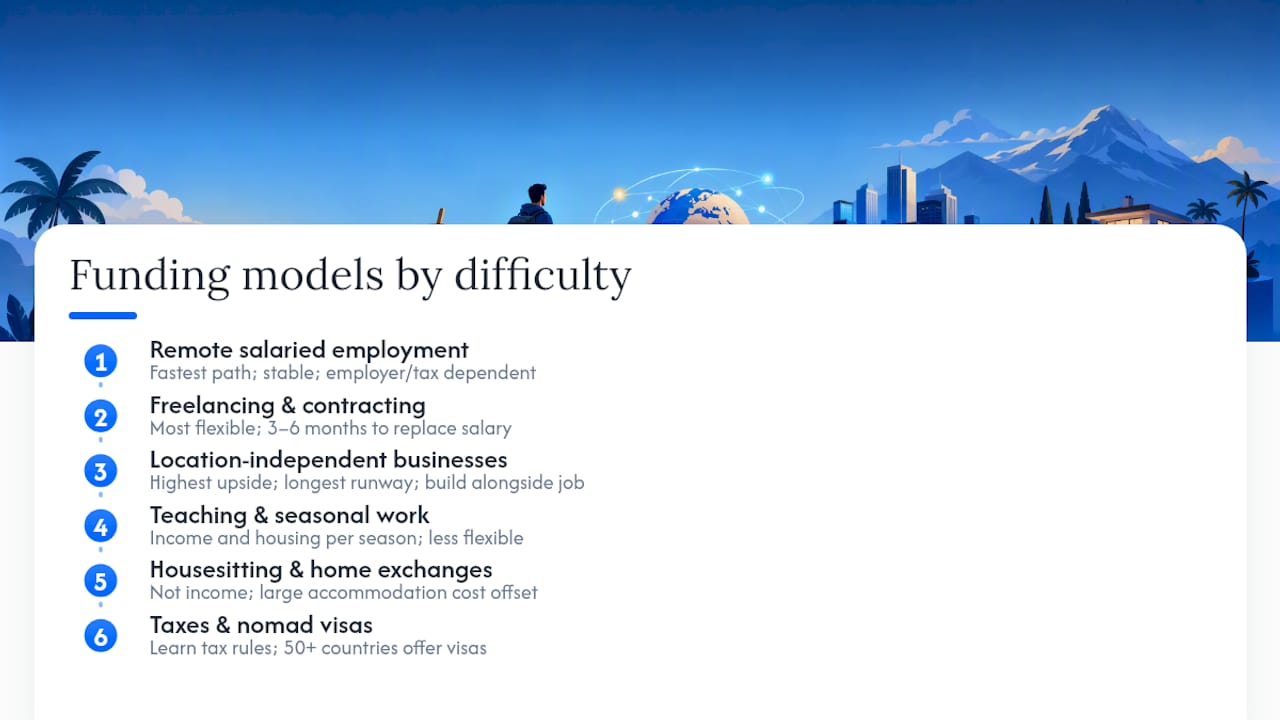
Remote salaried employment is the fastest path if you already have a job that can be done on a laptop. Negotiate a remote arrangement before you move. Many employers will agree to a trial period, especially post-2020. Stability is high; geographic flexibility depends on your employer’s policies and your tax residency situation.
Freelancing and contracting takes longer to build but gives you the most flexibility. Common entry points: writing, design, software development, marketing, consulting, bookkeeping, and video production. Expect 3–6 months to replace a meaningful portion of salary if you’re starting from scratch. Platforms like Upwork, Toptal, and LinkedIn are the standard starting points.
Location-independent businesses — e-commerce, SaaS, content publishing, online courses — offer the highest upside but the longest runway. Most people build these alongside a day job before going full-time.
Teaching and seasonal work (English teaching abroad, ski/surf instruction, yacht crew) provides income and housing in one package, though it ties you to a specific location for a season. Less flexible, but a good bridge for people who aren’t yet remote-capable.
Housesitting and home exchanges through platforms like TrustedHousesitters or HomeExchange dramatically cut accommodation costs. Not income, but a cost offset that changes the math significantly.
A note on U.S. taxes: If you run a U.S.-based business while traveling, or employ a family member in your operation, IRS guidance for small businesses and self-employed taxpayers covers the rules you need to understand before you change your working location. Tax residency, foreign income exclusions, and payroll rules for family employees are all areas where a CPA with international experience is worth the fee.
Many countries now offer digital nomad and remote-work visas that expand long-stay options beyond the standard 90-day tourist window. Portugal, Costa Rica, Thailand, and over 50 other countries have formal programs as of 2026.
How to start: a practical 30/90/365-day plan
The staged approach is the one that actually works. Small tests before major commitments are consistently what separates people who make the transition from people who plan it indefinitely.
30 days: test the concept
Have the remote-work conversation with your employer, or identify one freelance skill you can monetize within 60 days.
Open a multi-currency account (Wise or Charles Schwab’s no-fee international debit are the standard choices for U.S. travelers).
Build a 1–2 month emergency fund if you don’t have one.
Book a 2–4 week remote-work trip somewhere with reliable broadband. Test your full work setup from a different location.
Track every expense during the trip to build a real cost baseline.
Questions to ask before moving to 90 days:
Did my productivity hold up during the test trip?
Was the broadband reliable enough for video calls?
Did I feel isolated, or did I find community quickly?
Are my income sources stable enough to cover 3 months of travel costs?
90 days: build the infrastructure
Negotiate a permanent remote arrangement or grow freelance income to cover at least 50% of monthly expenses.
Switch to a travel health insurance plan (World Nomads and SafetyWing are the two most commonly used by U.S.-based travelers; compare coverage for your specific destinations).
Set up a virtual mailbox service (Traveling Mailbox and PostScan Mail are reliable options) and update your address with the IRS, banks, and any subscriptions.
Trial a 1–3 month long-stay in one location to test the rhythm of slower travel.
Open a dedicated business bank account if you’re freelancing, and consult a CPA about your tax residency status.
Pro Tip: During your first long-stay, book a furnished monthly rental rather than Airbnb nightly rates.
365 days: optimize the system
Decide on your housing base: sublet your U.S. apartment, sell, or keep a minimal storage unit.
Establish a mail forwarding and registered agent setup if you have a business entity.
Review your tax residency and visa situation with a CPA and immigration attorney if you’ve spent significant time outside the U.S.
Build repeatable travel logistics: a go-to packing list, a preferred SIM/eSIM setup, and a coworking membership that works across cities (Selina and WeWork both offer multi-location passes).
Evaluate whether your income has grown enough to support the lifestyle sustainably.
Sample monthly budget ranges (qualitative):
These are directional ranges based on widely reported nomad cost data, not guarantees. Your actual costs depend heavily on travel frequency, accommodation choices, and lifestyle preferences.
What logistics actually make continuous travel sustainable?
Most people underestimate the operational side. Here’s what matters most.
Housing
Monthly rentals beat nightly rates at almost every price point once you’re staying more than two weeks. Furnished Finder, Spotahome, and direct outreach to property managers on Facebook Marketplace are the most cost-effective channels. Housesitting through TrustedHousesitters can cut accommodation costs to near zero in exchange for pet care.
If you want to keep a U.S. base, a room in a co-living space or a subletter in your apartment is cheaper than paying full rent on an empty unit.
Mail and administration
A virtual mailbox handles physical mail digitally. Traveling Mailbox, PostScan Mail, and Earth Class Mail are the three most-used services among U.S. travelers. If you have an LLC or S-corp, you’ll also need a registered agent in your state of formation. Northwest Registered Agent and Registered Agents Inc. are standard choices.
Health and insurance
Travel health insurance is non-negotiable for anyone spending more than a few weeks abroad. World Nomads covers most adventure activities and has a straightforward claims process. SafetyWing’s Nomad Insurance is cheaper and works well for lower-risk destinations. Neither replaces a U.S. health plan if you plan to spend significant time stateside, so check whether your current plan has international coverage before canceling it.
Carry a one-page medical summary: blood type, allergies, current medications, and emergency contacts. It takes 20 minutes to create and has saved travelers hours in foreign emergency rooms.
Packing and minimalism
Carry-on-only travel removes checked-bag fees, eliminates lost-luggage risk, and makes you faster through airports. The standard framework: one 40L carry-on backpack (Osprey Farpoint 40 and Peak Design Travel Backpack 45L are the two most recommended), a capsule wardrobe of 7–10 versatile pieces, and a tech pouch with all cables and adapters.

Pro Tip: Pack for your destination’s laundry access, not its weather. A merino wool base layer washes overnight and works across climates. It’s the single item most experienced travelers say they’d never leave behind.
Connectivity
A global eSIM (Airalo and Holafly are the most widely used) gives you data in most countries without swapping physical SIMs. For backup, a Skyroam or GlocalMe hotspot covers gaps. A VPN (Mullvad or ExpressVPN) protects your connection on public networks and lets you access U.S.-based services from abroad.
For work, test broadband speed before committing to a long-stay. Speedtest.net and Nomad List both publish crowd-sourced broadband data by city. A coworking day pass is worth the cost during your first week in any new city, even if you end up working from your apartment the rest of the time.
Which services and tools support a travel-first life?
The right stack depends on how frequently you move and what you’re optimizing for. Here’s how to think about each category.
Flight access
For frequent travelers who value speed and spontaneity over lowest-cost fares, private aviation access comes in three main forms: charter, fractional ownership, and empty-leg memberships. Empty-leg memberships are the most accessible entry point for people who can be flexible on timing.
Bluebirdjets is built specifically for this use case. The annual membership gives unlimited access to published empty-leg flights on operator-owned Learjet 60 jets, with the ability to bring up to six guests per flight. Members get live inventory with daily updated routes, priority booking features, and a Skip-the-Line option for high-demand legs. Frequent private flyers who can work around last-minute availability get the most value from this model. It’s not for someone who needs a specific route on a specific date; it’s for someone who sees an available leg to a city they want to visit and books it the same day.
For readers evaluating flight membership options, the key criteria are: blackout restrictions, guest policy, geographic coverage of available legs, priority booking access, and whether custom charter quotes are available when the empty-leg inventory doesn’t match your route. Bluebirdjets covers all five.
Banking and money
Wise (multi-currency account, real exchange rates, low transfer fees)
Charles Schwab (no international ATM fees, reimburses charges globally)
Revolut (good for currency conversion, less reliable for U.S. tax reporting)
Mercury (best for U.S.-based freelancers and LLC owners who need a business account)
Tax and accounting
QuickBooks Self-Employed or FreshBooks for income tracking
A CPA with international experience for annual filing, especially if you’re claiming the Foreign Earned Income Exclusion (Form 2555) or have foreign bank accounts (FBAR filing via FinCEN 114)
Productivity and communication
Notion or Obsidian for knowledge management and trip planning
Slack or Discord for async team communication
Zoom and Loom for client calls and async video updates
1Password for password management across devices and locations
Pro Tip: Set up a dedicated “travel ops” folder in your note-taking app with sub-pages for: current visa status, insurance policy numbers, emergency contacts, and a running list of coworking spaces you’ve tested. You’ll reference it more than you expect.
How do you protect your mental health and relationships on the road?
The wellbeing research is clear: travel supports mood, resilience, and cognitive health, but the benefits aren’t automatic. They depend on how you design the experience.
Research synthesized by mindbodygreen shows that travel’s health advantages come from specific behaviors — movement, nature exposure, social connection, and cognitive challenge. Passive travel (hotel room, pool, repeat) delivers fewer of those inputs. Active, socially rich travel delivers more.
Mindset and integration practices convert experiences into lasting growth. Journaling after a meaningful day, setting a learning intention before a trip, and building in reflection time are the habits that separate people who feel enriched by travel from people who just feel tired.
Daily habits that protect mental health while traveling:
Maintain one consistent morning routine regardless of location (even 20 minutes of movement and coffee)
Schedule weekly video calls with close friends or family, not just reactive check-ins
Join one local activity per city: a language class, a sports league, a coworking community
Limit consecutive travel days to avoid decision fatigue and social depletion
Keep a short gratitude or reflection log to anchor meaning to specific experiences
Relationships require a different kind of attention when you’re mobile. Shared travel plans with close friends or a partner, scheduled home-base visits, and clear communication about your availability windows all reduce the friction that distance creates. The people who maintain strong relationships while living a travel-first life tend to be more deliberate about communication than they were when they lived nearby.
A New Scientist review of psychological literature found mood benefits remain elevated for at least 21 days after returning from a trip, with eudaimonic activities producing effects lasting up to eight weeks. That’s a meaningful window. Short, frequent trips designed around purposeful activity deliver more sustained wellbeing than a single long vacation, which means the travel-first model is actually better suited to maximizing these benefits than the traditional two-weeks-a-year approach.
Your 30/90/365-day checklist
Use this as a working document, not a reading list.
30-day actions
[ ] Have the remote-work conversation with your employer (or identify your freelance skill)
[ ] Open a Wise or Charles Schwab account
[ ] Build a 1–2 month emergency cash buffer
[ ] Book a 2–4 week test trip with full remote-work setup
[ ] Track all trip expenses to build a real cost baseline
90-day actions
[ ] Secure a stable remote income covering at least 50% of monthly expenses
[ ] Switch to a travel health insurance plan (World Nomads or SafetyWing)
[ ] Set up a virtual mailbox (Traveling Mailbox or PostScan Mail)
[ ] Trial a 1–3 month long-stay in one location
[ ] Consult a CPA about tax residency and any IRS filing changes
365-day actions
[ ] Decide on your U.S. housing base (sublet, sell, or minimal storage)
[ ] Establish a registered agent if you have a business entity
[ ] Review visa and tax residency status with a CPA and immigration attorney
[ ] Build a repeatable packing list and SIM/eSIM setup
[ ] Evaluate income sustainability and adjust the model if needed
Milestone | Priority actions | Cost band |
|---|---|---|
30 days | Remote work test, emergency fund, multi-currency account | Low setup cost |
90 days | Health insurance, virtual mailbox, first long-stay trial | Medium added monthly cost |
365 days | Housing decision, tax/visa review, scalable logistics | Variable (depends on housing) |
What most people get wrong about living travel-first
The conventional wisdom says you need to save aggressively for a year, quit your job, and go. That’s the version that looks good in a YouTube thumbnail. It’s also the version most likely to fail.
The people who make travel-first living work long-term almost always do it in stages. They negotiate remote work before they move. They test a long-stay before they give up their apartment. They build a second income stream before they need it. The staged approach isn’t timid; it’s how you avoid the expensive reset that comes from burning your bridges before you’ve validated the model.
There’s also a subtler mistake: optimizing for cost at the expense of quality of life. Staying in the cheapest accommodation in a city you don’t like, grinding through back-to-back travel days to cover more ground, treating every destination as a checkbox. The research on eudaimonic wellbeing is clear that depth beats breadth. One month in a city where you’ve built a routine, found a gym, and made a few friends delivers more lasting benefit than four cities in four weeks.
The last thing worth saying: the travel-first lifestyle isn’t a permanent state for most people. It’s a phase, or a rhythm, or a set of habits that you dial up and down depending on where you are in life. The goal isn’t to be perpetually nomadic. It’s to build enough flexibility into your work and finances that travel is always available to you as a real option, not a fantasy you’re saving for retirement.
Bluebirdjets membership for spontaneous frequent flyers
If you’re flying more than a few times a year and you value speed over price, the math on commercial aviation starts to break down fast. Time in security lines, connection layovers, and fixed schedules are friction costs that compound across dozens of trips.
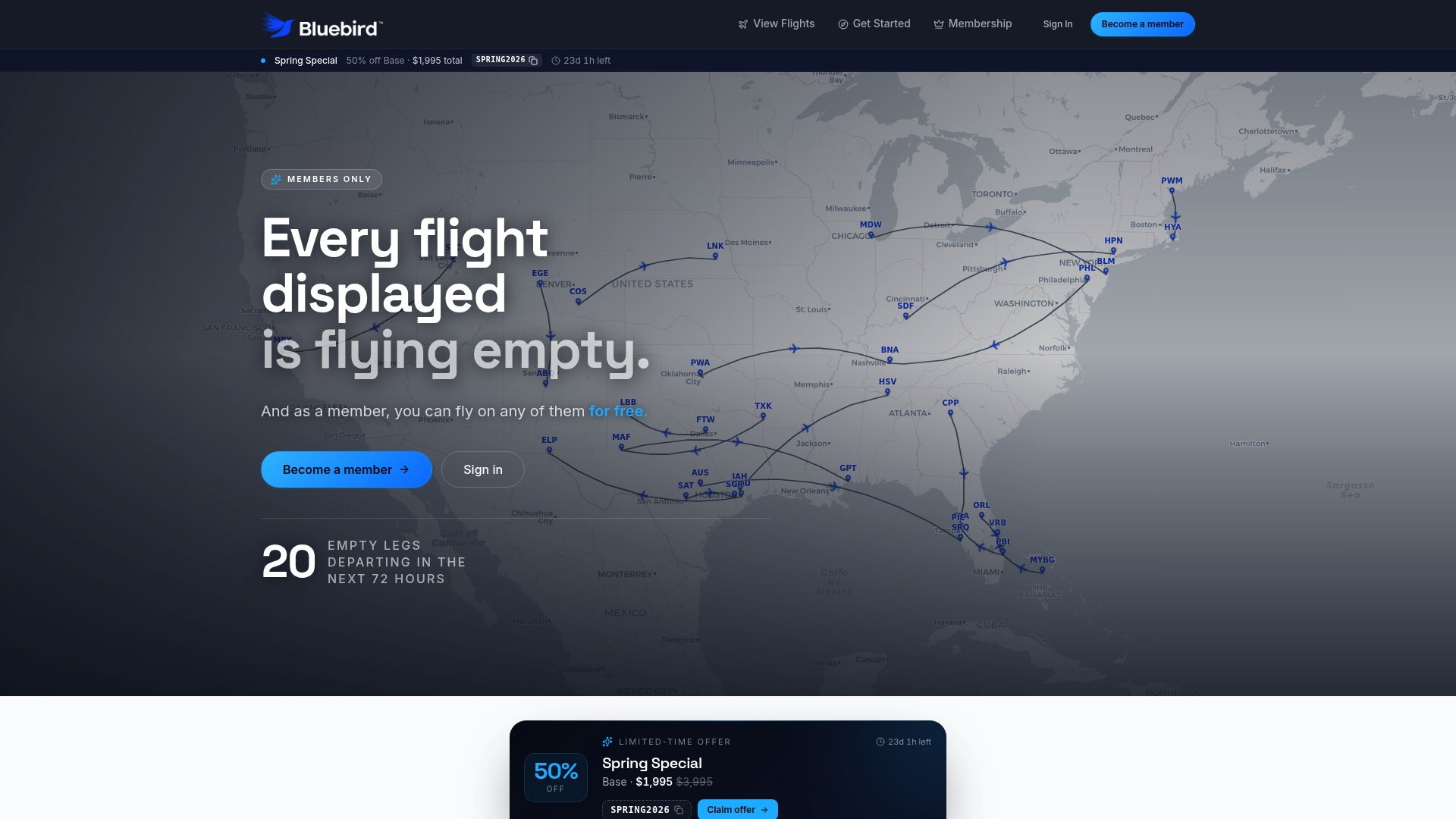
Bluebirdjets offers an annual membership that gives you unlimited access to published empty-leg flights on Learjet 60 jets. You can bring up to six guests per flight, access live inventory with daily updated routes, and use priority booking to secure legs before they fill. A Skip-the-Line upgrade is available for high-demand routes. For members who want a specific route outside the empty-leg inventory, custom charter quotes are available separately.
The membership fits a specific profile: you fly frequently, you can be flexible on timing, and you want last-minute private access without negotiating a charter quote every time. If you need a guaranteed seat on a specific route on a specific date, a traditional charter is the better fit. If you can work around availability and want to move fast when a leg opens up, the Bluebirdjets model is built for you.
Check current available flights to see what empty-leg inventory looks like right now, or visit the membership page to review the full benefits and pricing.
Sources
How to maximise the mental health benefits of your vacation | New Scientist
How Travel Supports Brain Health, Stress Resilience & Longevity | mindbodygreen
How Travel Can Help Us Live Longer and Fight Aging, According to Science | Vogue
Leisure travel frequency and quality of life — tourism research (SAGE)