Private Jet Membership Cost for U.S. Flyers: Empty Leg Math

Private Jet Membership Cost for U.S. Flyers: Empty Leg Math
Private jet membership cost usually starts with annual dues of roughly $5,000 to $17,500 on many programs, per industry analysis, while the flight hour is billed on top. Hourly rates vary by aircraft class and carry U.S. taxes and surcharges. Memberships favor flexible, spontaneous flyers, and ownership only pays off at far higher annual hours.
TL;DR:
- Total trip invoices can run 20% to 35% above base rates; include federal taxes, fuel, repositioning, crew waiting time, and airport fees.
- Below about 15 annual flight hours, dues rarely pay off; compare annual fees, quoted flight charges, taxes, and surcharges against your actual use.
- Plus costs $6,000 more annually than Base, but repeated $2,000 priority upgrades make Plus cheaper once you need priority more than three times yearly.
- Empty leg routes and dates follow aircraft schedules and can change; membership gives access to published flights, not control over departure timing.
- Prepaid balances put more cash at risk than annual dues, so get refund, expiry, renewal, and provider failure protections in writing before paying.
Table of Contents
- What does a private jet membership cost up front?
- How do dues-funded, capped-rate, and deposit models work?
- What are typical hourly rates and extra fees?
- How does membership compare with owning or sharing a jet?
- How do you calculate whether a membership saves money?
- Base vs Plus: which membership tier costs less over time?
- What are empty legs, and why does unlimited access matter?
- How do you join, and what does it cost to get started?
- What happens if you cancel or change plans?
- What to check before you sign anything
- Which membership fits spontaneous U.S. flyers?
- FAQ
- Sources
What does a private jet membership cost up front?
Programs can use dues-funded memberships, capped-rate memberships, or deposit-funded jet cards. Expect the following bands, and treat them as market ranges rather than quotes:
- Dues-funded memberships: an annual access fee, with flights billed as flown. Many programs land around $5,000 to $17,500 per year, according to The Jet Finder’s 2026 comparison, and some marketplace memberships start lower or higher.
- Capped-rate memberships: higher dues in exchange for published hourly ceilings by aircraft class.
- Deposit-funded jet cards: large prepaid deposits that buy locked hourly rates and stronger availability guarantees. These can require tens of thousands of dollars or more upfront.
The annual fee pays for technology, concierge support and priority access. It does not pay for the flight itself, which is why two programs with identical dues can produce very different yearly totals.
How do dues-funded, capped-rate, and deposit models work?
Each model shifts risk and cash in a different direction, so identify which one you are being sold before comparing prices.
- Dues-funded: you pay for access, then pay for each flight at member or market rates. Your cash exposure is limited to the annual fee.
- Capped-rate: the operator publishes an hourly ceiling for each aircraft class. Check the contract for the conditions and exceptions that apply.
- Deposit or jet card: you prepay hours at a locked rate and receive stronger contractual availability. Bravo’s market analysis draws the same line between prepaid cards with locked rates and dues models with per-flight billing.
Cash posture matters most with deposits. A prepaid balance is money you have handed to a counterparty, and your protection depends on the contract language about refunds, expiry and what happens if the provider runs into trouble. Dues-only models cap your downside at one year’s fee.
Pro Tip: Ask any provider to state in writing whether your money is a non-refundable fee or a refundable deposit, and where deposit funds are held.
What are typical hourly rates and extra fees?
Hourly bands run from lower rates for light jets to the highest for heavy jets, with midsize and super-midsize aircraft in between, and rates vary within each class by aircraft age, region and demand. Bravo’s analysis gives ballpark bands for each class and notes that whether a membership pays off depends on how often you fly and the program’s fees and rates, so check its published bands against any quote you receive.
The headline rate is not the final invoice. The IRS audit guide on air transportation says charter invoices commonly include hourly charges, fuel costs and surcharges, crew waiting time, deadhead or repositioning, and landing and parking fees. Operators also collect and remit the applicable excise taxes.
Budget for these common additions:
- Fuel surcharges: these follow fuel prices, which IATA reporting shows can swing meaningfully.
- Repositioning and overnight crew: billed when the aircraft or crew must move to or stay near your trip.
- De-icing and handling: charged at the airport.
Some “all-inclusive” rates fold these components into a higher headline hourly fee. Compare total invoices, not hourly figures.
How does membership compare with owning or sharing a jet?
Membership sits at the low-capital, high-flexibility end of the spectrum, and ownership sits at the opposite end.
- Full ownership: you carry the purchase price, crew, hangar, insurance and maintenance. It tends to make sense only at very high utilization.
- Fractional ownership: commentary from Private Jet Card Comparisons describes a multi-year commitment, a share buy-in, monthly management fees and occupied hourly charges, usually economical only at much higher utilization.
- Jet cards: a prepaid deposit buys locked rates and stronger availability guarantees, with money tied up until you fly the hours.
- Memberships: your exposure is the annual dues, and you buy flights as you need them.
The National Aircraft Finance Association contrasts these models, warns about advance-notice requirements, and notes that repositioning and taxi or engine run time can be included in invoiced hours. Aircraft consistency also differs: ownership and fractional programs give you a known cabin, while memberships and cards may place you on different aircraft. That affects effective cost, because a guarantee you never use is money spent on comfort rather than flying. If you fly occasionally and want spontaneity, committing capital to ownership rarely beats a lighter structure. For a broader primer, see our guide to types of private aviation access.
How do you calculate whether a membership saves money?
Gather five inputs: annual flight hours, your typical aircraft class, average one-way leg length, expected surcharges, and how much advance notice you can live with. Then run the formula:
- Add your annual dues.
- Add your projected flight invoices at the rates you were quoted.
- Add taxes and surcharges, using the 20–35% range as a stress test.
- Divide the total by your flight hours to get your effective hourly cost.
Two illustrative scenarios, with inputs that are examples rather than market data:
- Low-utilization flyer, 8 to 12 hours a year: dues get spread over very few hours, so the effective hourly cost jumps. This matches Bravo’s guidance that memberships rarely pay off below about 15 hours, so a membership is unlikely to save you money here.
- Frequent spontaneous flyer: dues shrink to a smaller share of each hour, and capped or deposit solutions may become economical.
Pro Tip: Run the formula twice, once with the advertised rate and once with surcharges added at the high end, and trust the second number.
For worked figures, see our private aviation cost breakdown examples.
Base vs Plus: which membership tier costs less over time?
We offer two annual tiers. Base is $3,995 per year and Plus is $9,995 per year. Both give members access to our empty-leg inventory, so the question is what the extra $6,000 buys.
Plus is built for members who want higher priority when several people want the same flight. Base members can still book and join the queue, and the optional Skip-The-Line fee of $2,000 one-off lets a Base member move up on a specific flight. That gives you a simple break-even: if you expect to need priority more than three times in a year, Plus costs less than paying the fee repeatedly. If you only need priority once or twice, Base plus the fee is cheaper.

The decision comes down to how competitive your routes are and how rigid your travel dates are. Flexible flyers who can wait for the next listing often do fine on Base. Flyers who need a specific route on a specific day, or who travel in busy windows, tend to value Plus. Neither tier changes the taxes and surcharges on your trip, so budget for those either way. Our post on whether an empty-leg membership is worth the annual fee walks through the math.
What are empty legs, and why does unlimited access matter?
An empty leg is a flight an aircraft must make without passengers, usually because a charter customer was dropped off and the jet is returning to its home base or heading to its next pickup. The seat cost is already a sunk cost for the operator, so these flights are often priced far below a normal charter.
The catch is timing. Empty legs appear on the operator’s schedule, not yours, so routes and dates are fixed and often announced at short notice. That is why the model rewards flexibility.
Unlimited access changes the economics. With a typical pay-per-flight approach, every empty leg you take adds its own charge. With our membership, you pay the annual fee and then fly published empty legs on our published empty-leg flights without a per-flight charge. Check the listing or membership terms for aircraft and guest details. Each additional flight lowers your effective cost per trip, the opposite of an hourly model where more flying means a bigger invoice. Our live inventory is updated daily, and you can see current listings on our flights page. Applicable taxes may still apply, which we cover in our piece on taxes for empty-leg members.

How do you join, and what does it cost to get started?
Joining is a short online process rather than a contract negotiation. You choose Base or Plus on our membership page, pay the annual fee, and your account opens with access to the live inventory of empty-leg flights.
The fees are straightforward:
- Base: $3,995 per year.
- Plus: $9,995 per year.
- Skip-The-Line: $2,000 one-off, an optional add-on for a specific flight.
The listed membership prices are annual. If you want a trip that does not match a published empty leg, you can submit a custom charter request on our get-started page, which is quoted and billed separately from your membership.
After joining, your routine is simple. Browse the daily-updated routes, join the queue for flights you want, and watch for ones that fit your calendar. For exact payment schedule options, ask our team before you commit, since this article only states the annual prices we list. Our guide on flying private without charter cost covers practical tactics for new members.
What happens if you cancel or change plans?
Cancellation and refund terms are among the first things to verify in writing, for any program. The contract that governs your membership controls what is refundable, so read it before paying.
For our Base and Plus plans, we will not guess at any penalty schedule. What we can say is how to approach it. Confirm in writing whether the annual fee is refundable in whole or part, whether it renews automatically, and how much notice you must give to stop renewal. Ask the same about Skip-The-Line: whether the $2,000 is refundable if a flight is cancelled or you drop out of the queue.
Two practical points help whichever plan you choose. First, empty-leg flights depend on the operator’s schedule, so a listed flight can change if the aircraft’s plans change, and you should understand your options when that happens. Second, if you are unsure Plus is worth it, starting on Base and paying for priority only when you need it limits your commitment. Our team can confirm current terms before you pay, and you can reach us through the get-started page.
What to check before you sign anything
Everything above points to a short checklist, and it is the one we would use ourselves. Verify these in writing: the refund policy, the fuel surcharge formula, how segment fees and the Federal Excise Tax are handled, and the availability and priority rules.
Then adjust how you book. Turn on empty-leg notifications, keep your departure window flexible, and avoid peak holiday dates, where pricing and competition for seats both climb. Empty-leg membership rewards spontaneity, and it works best when you treat a listing as an opportunity to grab rather than a trip to plan months out. The honest expectation to set is that you choose from published flights, not the other way around. Travelers who accept that trade a little control for a very low cost per trip.
— Nick
Which membership fits spontaneous U.S. flyers?
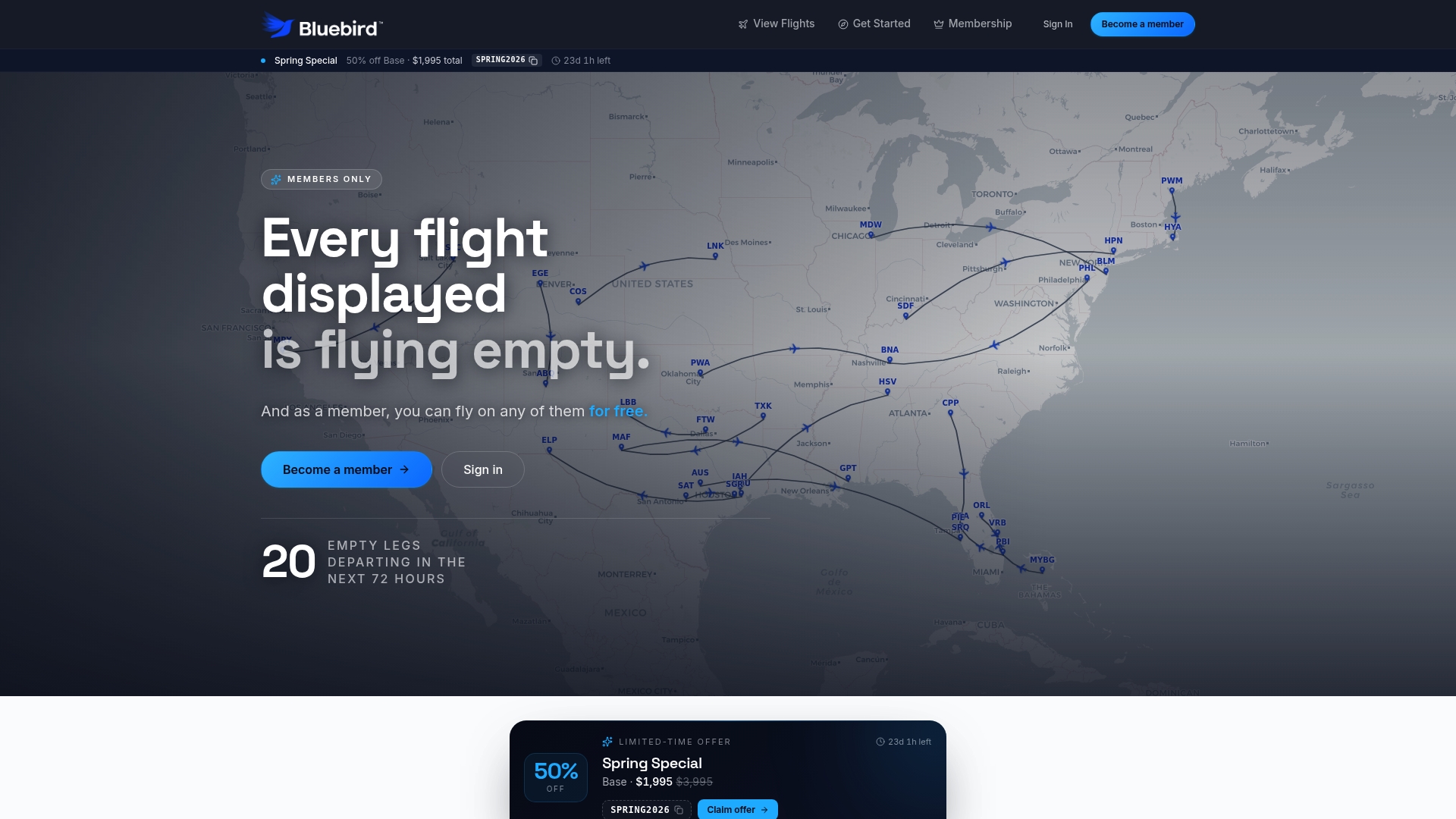
If your calendar bends and you want private flights without tying up capital, our membership is built for you. We give you unlimited access to published empty-leg flights on our Learjet 60 jets, priority booking, room for up to six guests, and optional custom charter requests.
- Base at $3,995 per year for flexible flyers.
- Plus at $9,995 per year for higher priority.
- Skip-The-Line at $2,000 one-off when one flight matters.
Compare both tiers and join on our membership page.
FAQ
Is NetJets worth it for private jet travel?
It depends on how often you fly and how much capital you can commit. Fractional and card programs suit people who fly frequently and want guaranteed availability, while lighter structures suit occasional or spontaneous flyers. Compare the commitment length and fees against your annual hours.
How much does a private jet membership cost per year?
Dues commonly run about $5,000 to $17,500 annually across many programs, according to The Jet Finder, with some marketplace options lower or higher. Our own Base plan is $3,995 per year. Flights are billed separately in most dues-funded models.
Is owning a private jet worth it?
Ownership usually makes sense only at very high annual flight hours. Fractional ownership still requires a multi-year commitment, monthly management fees and occupied hourly charges. For occasional flying, a membership or jet card limits your capital at risk.
What taxes apply to private jet charters in the U.S.?
Charter operators collect and remit the applicable federal excise taxes. The FAA lists the current excise tax structure, including the 7.5% charter tax and per-segment fees. Ask any provider how these appear on your invoice.
Sources
- Trust Fund Excise Taxes Structure
- Publication 510 (12/2025), Excise Taxes | Internal Revenue Service
- Private Jet Memberships Compared | 2026 Guide | The Jet Finder
- Membership Programs vs Jet Cards Compared · Bravo
- NOTE: This document is not an official pronouncement of the law or the position of the Service and can not be used, cited, or relied upon as such