Make Private Jet Standby Reliable With Guaranteed Empty Leg Access

Make Private Jet Standby Reliable With Guaranteed Empty Leg Access
Empty-leg standby works well for travelers who can fly on the aircraft’s schedule, not their own. It fails the moment your dates or destination are fixed. For anyone who wants both spontaneity and reliability, a membership that guarantees empty-leg access, like Bluebirdjets, closes the gap that pure luck leaves open.
TL;DR:
- Empty-leg discounts can reach up to 75 percent but are usually much narrower, especially on popular routes, peak periods, or last-minute bookings.
- Flights are tightly scheduled, with departure windows often only one to three hours, and routing fixed, limiting flexibility and last-minute changes.
- If the originating paid charter cancels or reroutes, the empty leg usually becomes void, and operators rarely offer substitutes or refunds.
- Membership programs like Bluebirdjets provide priority access to daily-listed inventory and reliable booking conditions, especially for frequent spontaneous travelers.
- Most standby inventory involves light jets flying short, regional routes between major hubs like New York, Miami, or Los Angeles, often from secondary airports.
Table of Contents
- What Does Private Jet Standby Actually Mean?
- How Empty-Leg Pricing And Timing Actually Work
- Why A Standby Leg Can Vanish, And How To Protect Your Trip
- Where To Find Standby Seats And How Booking Actually Works
- Standby, Guaranteed Charter, Or Membership: Which One Fits Your Trip?
- A Step-By-Step Playbook For Booking Standby
- How Membership Changes The Standby Equation
- What Flyers Actually Say About Booking Standby
- Comparing Standby Options Across Providers
- What Kind Of Aircraft Show Up On Standby
- Which Airports Produce The Most Standby Inventory
- A Spontaneous Weekend, Start To Finish
- Get Guaranteed Empty-Leg Access With Bluebirdjets
- Sources
What Does Private Jet Standby Actually Mean?
Private jet standby usually refers to empty-leg flights, sometimes called deadhead or repositioning legs. These are one-way trips an aircraft has to fly anyway, empty, to get back to base or reposition for its next paid charter. Rather than fly it empty, operators list the seat for sale at a reduced price. It’s not a discount out of generosity. It’s a way to recover fuel and positioning cost on a flight that was happening regardless of whether you bought a ticket.
That’s fundamentally different from a guaranteed charter, where you pick the date, the airports, and the aircraft, and the operator commits to flying it for you specifically. Standby only exists because someone else already booked the trip that created the empty leg.
Behind every listing sits an FAA Part 135 certificate, the regulatory category that governs commercial charter operations in the United States. Reputable operators also carry third-party safety audits from ARGUS or Wyvern, which vet maintenance records, pilot training, and operational history beyond what the FAA requires. Skipping this check on a discounted flight is where inexperienced buyers get burned.
A few structural facts worth knowing before you start hunting for a deal:
- Empty legs exist because aircraft must reposition between paid trips, and operators discount them to offset that unavoidable flight.
- Reserve crews and aircraft are held on standby by the operator, not scheduled specifically around your request.
- A guaranteed charter locks in your dates; an empty leg locks in the operator’s dates and hopes you can match them.
- Part 135 certification and ARGUS or Wyvern ratings are the baseline safety credentials to confirm before paying for any standby seat.
How Empty-Leg Pricing And Timing Actually Work
Empty-leg pricing follows a predictable arc, and understanding it prevents disappointment. Brokers and operators sometimes call it the 5-Day Rule: a leg posted three weeks out often prices close to retail, because the operator still expects a paying customer to book the full charter and bump the empty leg off the board entirely. Discounts typically deepen as departure closes in, with the steepest price drops showing up inside the final 72 hours.
That timing dynamic isn’t marketing spin. It reflects a simple math problem for the operator: an unsold seat at takeoff earns zero dollars, so pricing on legs approaching departure often reprices downward in real time to capture whatever revenue is still recoverable.
Discounts of “up to 75%” make for a great headline, but treat that number as a ceiling, not an average. Most usable discounts fall in a much narrower, less dramatic range, and the deepest cuts tend to appear on odd routes, midweek dates, or red-eye departures that struggle to find buyers even at a lower price.
A few things to lock down before you commit money:
- Departure windows on empty legs are typically tight, often just one to three hours of flexibility around the posted time, not the wide-open scheduling you’d get with a guaranteed charter.
- Routing is fixed. The leg flies from Point A to Point B because that’s where the aircraft needs to go, not because it fits your itinerary.
- Confirm the display price actually includes Federal Excise Tax, fuel surcharges, and segment fees, since some listings quote a base number that grows once these are added.
- Ask whether the price shown is locked or subject to change before departure, since some operators reprice dynamically.
Why A Standby Leg Can Vanish, And How To Protect Your Trip
The single biggest risk in private jet standby is that the empty leg you booked was never really yours to guarantee. If the originating paid charter that created the leg changes, cancels, or reroutes, the empty leg you paid for can be voided, and the operator’s obligation typically stops at issuing a refund. Nobody owes you a replacement flight.
Other risks stack on top of that core fragility. Crew duty-time limits are strict under FAA regulations, and coordinating catering, permits, fuel, and legal crew rest on short notice is genuinely complicated behind the scenes, which is exactly why operators enforce minimum callout windows rather than promising instant departures. Add unscheduled maintenance, weather delays, and peak travel days (Thanksgiving week, the days around the Super Bowl, late December) when every aircraft in the fleet is already spoken for, and you get a product that’s genuinely opportunistic rather than dependable.
Protect anything that actually matters with a few non-negotiables:
- Hold a refundable backup charter for any trip with a hard deadline, like a wedding, a closing, or a board meeting.
- Get the cancellation and void clause in writing before you pay, not as a verbal assurance.
- Confirm the specific FBO (fixed-base operator terminal), tail number, and crew assignment rather than just a route and time.
- Ask directly whether the operator has a recovery aircraft policy if the original plane goes mechanical.
Pro Tip: Never book a single empty leg as your only way to reach a fixed, unmovable event. Treat it as your primary plan only when your schedule genuinely has zero fixed points.
Where To Find Standby Seats And How Booking Actually Works
Three main channels carry empty-leg inventory, and each trades freshness for control differently.
- Operator-direct listings come straight from the company flying the aircraft, which means the information is accurate but limited to that one fleet’s routes.
- Aggregator marketplaces pull listings from many operators into one feed, giving you broader route coverage but sometimes stale or already-sold postings.
- Broker email lists put a human between you and the inventory, useful for negotiation but slower than checking a live board yourself.
Membership programs solve the freshness problem differently. Rather than making you refresh a marketplace at midnight, they push saved-search alerts by SMS or email the moment a matching route appears, which matters enormously since the best-priced legs often surface and disappear within hours. Bluebirdjets structures alerts this way, pairing live inventory with priority queueing so members see relevant legs before the general public does.
Before you commit to any listing, regardless of channel:
- Verify the operator’s Part 135 certificate number and cross-check its ARGUS or Wyvern rating independently, not just by taking the listing’s word for it.
- Ask when the listing was last confirmed active, since aggregator feeds sometimes lag by hours.
- Get the cancellation policy in writing, including whether a refund is automatic or requires a request.
Standby, Guaranteed Charter, Or Membership: Which One Fits Your Trip?
Not every trip should chase a discount. Run your situation through a short mental checklist before deciding which product actually fits.
- How fixed is the date? If missing this trip carries real consequences, a discounted empty leg is the wrong tool. Book a guaranteed charter instead.
- How many people are traveling? Empty legs are built around a specific aircraft’s existing configuration; a group of eight won’t fit on a leg sized for a light jet.
- How flexible are you on airports? Standby rewards travelers willing to depart from a secondary field or land somewhere thirty minutes from their actual destination.
- Is this a peak travel period? Holiday weekends and major events shrink standby inventory dramatically as operators pull aircraft into paid charter service.
Frequent flyers who fit this pattern most of the year benefit from a different calculation entirely. A membership that guarantees empty-leg access, rather than one that just aggregates listings, turns “maybe there’s a leg available” into “check the live board and go.” Priority booking and queue position matter here specifically because the best legs get claimed fast, and a membership with priority access means you’re not competing against every casual browser on the platform.
Someone flying spontaneously four or five times a year is a strong standby candidate. Someone with one immovable trip to a daughter’s graduation should book that one on a guaranteed charter and save the standby hunting for everything else.
A Step-By-Step Playbook For Booking Standby
Before any alert even arrives, get your paperwork and expectations in order.
- Confirm your preferred operators’ Part 135 certification and ARGUS or Wyvern safety ratings in advance, so you’re not researching this under time pressure.
- Have payment details and passenger information (names, IDs, weight for smaller aircraft) ready to submit instantly.
- Know your all-in price threshold, including FET, fuel surcharges, and fees, before you’re emotionally invested in a specific listing.
When an alert actually lands, move fast but don’t skip steps:
- Confirm the exact FBO, tail number, and departure window in writing.
- Lock ground transportation on both ends before you pay, not after.
- Get the cancellation and void clause confirmed in writing, specifically what happens if the originating booking changes.
If the leg falls through, which happens, execute your contingency immediately: request the refund in writing the same day, and call your backup charter option rather than starting a fresh search from zero.
Pro Tip: Keep a running list of two or three trusted operators with confirmed certifications so you’re never vetting safety credentials for the first time while a departure window is closing.
How Membership Changes The Standby Equation
Chasing empty legs solo means competing against every other buyer refreshing the same marketplace, with no guarantee anything relevant appears before your window closes. Bluebirdjets built its membership around removing that uncertainty. Members get unlimited access to empty legs on the company’s operator-owned Learjet 60 aircraft, a live inventory board updated daily, and queue and priority booking that puts members ahead of the general public when a desirable route posts.
Members can also bring up to six guests per flight, which matters for anyone whose spontaneous travel usually includes family or friends rather than solo trips. For situations that fall outside published inventory, the membership includes optional custom charter requests, so a route gap doesn’t mean starting over with a different provider.
The math favors membership most clearly for people who fly opportunistically several times a year: the annual fee replaces the time cost of constant marketplace-refreshing and the financial cost of repeatedly booking refundable backup charters just in case a solo empty-leg search comes up empty. Membership economics tend to make the most sense for frequent flyers rather than occasional travelers, a threshold worth honestly assessing before joining any program.
What Flyers Actually Say About Booking Standby
The recurring theme in traveler accounts of empty-leg booking is the same tension every section of this guide keeps circling back to: speed versus certainty. Flyers who describe positive experiences almost always mention genuine schedule flexibility going in. They weren’t trying to make a specific wedding or closing; they were open to flying Thursday or Friday, to landing at a secondary airport, or to a departure time that shifted by ninety minutes.
The negative accounts cluster around a predictable mistake: booking an empty leg against a fixed commitment and getting burned when the originating charter changed. Industry observers have pointed out that empty-leg marketing sometimes functions more as a lead-generation tool for operators than a dependable retail product, which lines up with what shows up in traveler complaints: a flight advertised prominently that was never truly available to book, or one that vanished the moment a real paying customer needed the aircraft.
Travelers who use membership programs with published callout times and recovery-aircraft policies report noticeably fewer of these bait-and-switch moments, largely because those terms are disclosed and enforced before a problem happens rather than discovered afterward. That distinction, terms disclosed in advance versus terms discovered during a crisis, is what separates a smooth experience from a frustrating one.
Comparing Standby Options Across Providers
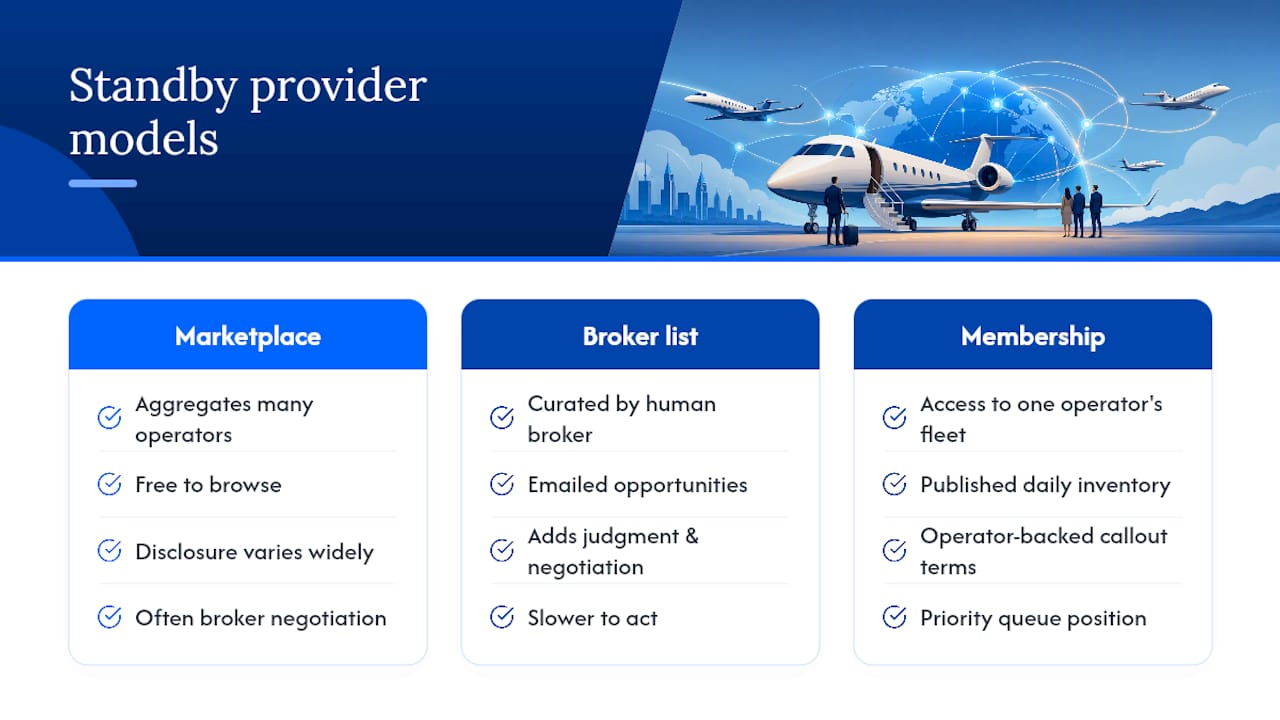
Not every empty-leg source structures its offering the same way, and the differences matter more than the marketing suggests. Some providers run pure marketplaces: they aggregate listings from many operators and charge nothing to browse, but disclosure varies wildly from listing to listing, and you’re often negotiating with a broker rather than the operator itself.
Other providers run broker-mediated lists, where a human curates and emails you opportunities. This adds a layer of judgment and negotiation help but slows down your ability to act on time-sensitive inventory.
Membership-based models, the category Bluebirdjets operates in, take a third approach: instead of aggregating other operators’ scraps, the membership grants access to a defined fleet’s empty-leg inventory, published daily, with the operator itself standing behind the callout terms and recovery policy. The trade-off is real and worth stating plainly. You’re limited to that operator’s routes and aircraft rather than every empty leg on the market, but in exchange you get published callout times, a documented recovery-aircraft policy, and priority queue position, three trust signals that pure aggregators generally cannot offer because they don’t control the underlying operation.
For travelers who value knowing the rules before they need them, the membership trade-off tends to look better the more frequently they fly. For someone booking once or twice a year, a broader marketplace with more route options may still make sense.
What Kind Of Aircraft Show Up On Standby
Light jets dominate empty-leg inventory, and there’s a structural reason why. Light jets like the Learjet 60 fly the highest volume of short repositioning trips between regional airports, which means they generate the most empty legs relative to fleet size. A Learjet 60 typically seats seven to eight passengers, cruises around 460 knots, and handles trips in the 1,500 to 2,000 nautical mile range, comfortably covering most domestic city pairs in a single hop.

Midsize jets and super-midsize aircraft show up on standby less frequently, generally on longer repositioning routes between major hub cities, and they command a smaller discount relative to retail because there’s more paid-charter demand competing for that same aircraft. Heavy jets and long-range aircraft appear on standby boards rarely, and when they do, the discount window tends to be brief because operators can usually place a heavy jet with a paying charter client quickly.
Amenities on standby aircraft mirror what you’d expect from that aircraft’s normal charter configuration. A light jet like the Learjet 60 typically offers leather seating, a private lavatory, and enough cabin space for a short work session or a relaxed conversation, though it won’t have the stand-up cabin height or the extended galley you’d find on a larger midsize or heavy jet. Matching your group size and comfort expectations to the aircraft category before booking prevents the surprise of arriving to find a cabin smaller than you pictured.
Which Airports Produce The Most Standby Inventory
Empty-leg inventory clusters around a predictable geography: routes between major financial and leisure hubs generate the highest volume, because that’s where paid charter demand is thickest and repositioning happens constantly. The Northeast corridor connecting New York-area airports, Boston, and Washington D.C. produces a steady stream of legs, largely driven by business travel that books one-way and leaves the return trip open.
Florida airports, particularly those serving Miami, Palm Beach, and the greater Orlando area, generate heavy standby volume during winter months as the seasonal snowbird migration creates lopsided demand, full flights heading south, empty aircraft needing to fly back north. The same pattern reverses in reverse during the spring.
The Los Angeles to Las Vegas corridor and routes touching Aspen or Jackson Hole during ski season also produce reliable empty-leg activity, since leisure charter demand is heavily one-directional around holidays and long weekends. Secondary airports near these hubs, rather than the major international gateways, tend to carry the best standby deals, since operators often reposition to smaller regional fields where landing fees and congestion are lower. If you live near or can easily reach one of these corridors, your odds of catching a well-priced standby leg improve considerably compared to searching from an airport with light charter traffic overall.
A Spontaneous Weekend, Start To Finish
An alert lands Tuesday night: an empty leg touching down near my weekend destination Friday afternoon. I confirm the operator’s certification, check the price against fuel and fee inclusions, and book within twenty minutes. Ground transport gets arranged Wednesday. When the departure time shifts by an hour Thursday, it barely registers. That’s the payoff flexible standby travel actually delivers.
— Nick
Get Guaranteed Empty-Leg Access With Bluebirdjets
Chasing individual empty-leg alerts works until the week you need one and none appear on your route. Bluebirdjets removes that gamble: membership gives you unlimited access to empty legs on the company’s own Learjet 60 fleet, a live inventory board updated daily, and priority queue position ahead of casual browsers checking the same listings.

Members can bring up to six guests per flight at no extra charge, and when the published inventory doesn’t cover where you need to go, optional custom charter requests fill that gap without forcing you to start over with another provider. For anyone flying spontaneously more than a couple of times a year, that combination of guaranteed access and priority booking solves the exact reliability problem this guide has spent the last several thousand words describing. Check current live empty-leg inventory and membership details to see what’s flying this week.
Sources
For a deeper technical breakdown of empty-leg pricing mechanics, SkyAccess’s buyer’s guide covers discount timing in detail. Peak Aviation’s broker explainer is the clearest resource on cancellation risk and refund norms. Jettly’s short-notice booking guide breaks down callout times and recovery-aircraft policies across the industry. For a skeptical industry take on empty-leg marketing claims, Private Jet Card Comparisons is worth reading before you trust any headline discount.
- How Do Empty Leg Flights Work? A 2026 Buyer’s Guide | SkyAccess
- What Is an Empty Leg Flight? | Peak Aviation
- Are cheap empty leg private jet flights a bait and switch?