Private Jet Blackout Dates: When They Hit and How to Fly Anyway

Private Jet Blackout Dates: When They Hit and How to Fly Anyway
Private jet blackout dates are days when a fixed-rate program, such as a jet card or a fractional lease, does not honor its normal rate or guaranteed availability. They cluster around Thanksgiving, the Christmas and New Year stretch, Memorial Day, the Fourth of July and big events like the Super Bowl. They rarely mean no private jet can fly. They mean the guarantee ends and the price, notice period or aircraft choice changes. Here is how the dates work, how to read the fine print, and what they mean if you fly empty legs.
TL;DR
- Blackout dates are a feature of fixed-rate programs, not a law or an industry-wide calendar. Every provider sets its own list.
- The usual suspects: Thanksgiving, Christmas to New Year, Presidents Day, spring break, Memorial Day, the Fourth of July and major sporting events.
- Many programs still let you fly on those days, but at a surcharge, with longer notice, or without the program’s guarantees.
- Empty legs are one-way repositioning flights, so they depend on what the schedule produces, not on a guarantee. Peak days tend to have fewer of them, so flexibility matters most then.
- Before you sign anything, ask for the dated list in writing and ask what happens on those dates.
Table of Contents
- What blackout dates actually are
- When blackout and peak dates usually fall
- Why providers have them
- What happens to price and rules on those days
- Can you still fly on a blackout date?
- Blackout dates and empty-leg flights
- Our view on blackout dates
- How to read any program’s fine print
- Planning a year around the calendar
- How Bluebird membership fits
- FAQ
- Sources
What blackout dates actually are
The term gets used loosely. In its strict sense, a blackout date is a day on which a program does not promise you an aircraft at your contract rate. Some programs list only a handful of days. Others publish a longer set of “peak” days with their own rules. The labels differ, and the provider’s contract is the only thing that counts.
Two things are worth separating:
- Blackout: the program does not guarantee a flight, or does not honor the standard rate.
- Peak day: you can usually fly, but with a higher rate, a minimum notice window, or fewer aircraft choices.
In practice, the two blur together. A card that advertises “no blackouts” may still carry a list of peak days with a premium. A program with four blackout days may have dozens of peak days. When you compare programs, compare the total number of restricted or surcharged days, not just the word on the homepage.
There is no single U.S. list. One operator may exclude a few year-end dates, another may skip blackouts entirely but publish peak periods with different guarantees, and a third may tie its restricted days to listed events. That is why a search for “the” blackout calendar never ends in one tidy answer.
When blackout and peak dates usually fall
The pattern is consistent even if the details are not. Demand spikes when many people with the means to fly privately want to be in the same places at the same time. SherpaReport’s guide to peak days lists the common U.S. peak periods as Thanksgiving, Christmas and New Year, Presidents Day, spring break, Memorial Day and the Fourth of July.
A rough working calendar looks like this:
| Period | What drives demand | Typical effect |
|---|---|---|
| Thanksgiving week and the Sunday after | Family travel, return trips bunch up | Tightest on Wednesday before and Sunday after |
| Mid-December to early January | Holidays, ski and beach destinations | Longest stretch of restrictions |
| Presidents Day weekend | Ski resorts | Mountain airports fill |
| Spring break (March, April) | Florida, Caribbean, Mexico, ski | Leisure hubs crowded |
| Memorial Day weekend | Start of summer travel | Short but sharp |
| Late June to July 4 | Summer vacations | Coastal and island routes busiest |
| Major events | Super Bowl, The Masters, other big sporting events | Local airports flooded for days |
Events deserve special mention. Some programs define their restricted days relative to an event, such as dates within a day of it and within a set distance of the host city. Even if your contract does not, the airport side has its own limits. For the 2026 Super Bowl, the FAA published a notice covering special event reservations and parking at nearby airports, and it warned that traffic would be well above normal. If you fly into an event city, the aircraft is not the only scarce thing. Ramp space is too.
The first tip is simple: put your own dates beside this table before you plan anything. If your trip lands inside a window, plan for friction.
Why providers have them
It is not arbitrary. On peak days, more travelers want a seat than there are aircraft to give them. The constraints are also physical: airport slots, parking space for parked jets, and crews and aircraft positioned where demand is. If you want a deeper look at the airport side, our guide to how airport slots work in private aviation explains why a destination can run out of room even when jets are available.
A fixed-rate program also has a pricing problem. It sells you a rate months in advance. On the busiest days, the cost of getting an aircraft to you can exceed that rate by a wide margin, so the contract carves those days out or adds a premium. It is a way to push some travelers toward quieter days and keep service workable on the busiest ones.
What happens to price and rules on those days
A blackout rarely shuts the door. It changes the terms. Here are the changes you are most likely to meet:
- A higher rate. One published example from a jet-card provider: its peak days allow flights at a rate 20% higher than the normal card rate, and it asks for 30 days’ notice to guarantee a trip, according to its peak-day policy. Yours may differ, but that is the shape.
- Longer call-out windows. SherpaReport reports peak-day notice periods typically running from 48 to 120 hours, against under 4 to over 72 hours on normal days, depending on the program.
- Bigger minimums. On peak days, some programs raise the daily flight minimum from 1.0 hour to 2.0 or sometimes 2.5 hours, which makes a short hop expensive.
- Fewer aircraft choices. You may not get the cabin class you booked.
- No benefits. Some memberships let you book on-demand charter on blackout dates, but the membership benefits do not apply.
What these have in common: the price you were quoted in the brochure is not necessarily the price you pay on the day you most want to fly. Our breakdown of fuel surcharges that can add thousands to a private flight and the piece on what custom charter quotes really include cover the other places a quote can grow.
Can you still fly on a blackout date?
Usually yes. If a fixed-rate program will not guarantee you an aircraft, you can often still request one from the charter market at market price. Options are tighter, and you will pay for that. Treat it as a different product from your card or membership, because the guarantee and the rate are the things that disappear.
If you must travel on a restricted day, these moves help:
- Shift the day. Leaving the Tuesday before Thanksgiving instead of the Wednesday, or returning Monday instead of Sunday, can move you out of the window.
- Shift the hour. Early morning or late evening departures often meet less competition than midday.
- Use a secondary airport. A less congested field near your destination can save you from slot and ramp problems.
- Book early. SherpaReport suggests booking four to six weeks ahead for peaks such as Thanksgiving or the winter holidays.
- Lock down ground transport too. If you are moving a group, the car or van at either end can be as tight as the plane. Booking vans before peak travel is the same logic applied to the ground.
For more on lead times and planning habits, see our private aviation booking best practices.
Blackout dates and empty-leg flights
Empty legs are a different animal. An empty leg is a flight an aircraft has to make with no passengers, because it is repositioning after dropping someone off or heading out to pick someone up. Nobody sells you a guaranteed seat on one. You take what the schedule produces.
That has two consequences around holidays.
First, there are no “blackout dates” in the contract sense, because there is no fixed rate to protect. What exists is inventory. Charter providers’ guidance notes that empty-leg availability tends to shrink around the busiest days, since the aircraft are busy flying paid trips in both directions. In plain terms: on the Wednesday before Thanksgiving, fewer jets are repositioning empty, because most are full both ways.
Second, flexibility becomes the whole strategy. The same quality that makes empty legs cheap (they follow the aircraft, not you) makes them less reliable when everyone wants the same route on the same day. You will not get your exact date and city pair on December 23. You may get a departure two days earlier from a nearby airport.
That is not a flaw. It is how the product works, and it is why we say it plainly: empty legs reward travelers who can move.
Our view on blackout dates
We built Bluebird around a simple observation. Most people who want private flying on short notice do not need a fixed rate on a specific holiday. They need access to flights that are already going somewhere, at a price that does not punish them for being spontaneous. That is what our membership is: unlimited access to the empty legs we publish, flown on our own Learjet 60 aircraft, with live inventory updated daily.
So we do not ask you to study a thick contract of restricted days and surcharge tiers. What we ask is that you look at what is actually flying. If a route exists on your date, you can see it. If it does not, you will know that too, and you can look at neighboring days. Our queue system is transparent, so you can see where you stand rather than wonder.

We will also be direct about the trade-off. A membership built on empty legs is not the tool for a wedding on a fixed Saturday in December in a specific city. For that, a custom charter quote is the honest answer, and we offer those separately. Our members are the ones who look at the board, see a flight to somewhere good, and go.
If you are comparing programs, the best question is not “Do you have blackout dates?” It is “What can I actually book on the days I care about, and what will it cost?”
— Nick
How to read any program’s fine print
Providers use the same words for different things, so ask for specifics. Before you sign, get answers in writing to these:
- Which dates are restricted or peak, and for which year? Ask for the actual dated list, not “major holidays.”
- How many days is that in total? Some programs that advertise no blackouts still maintain dozens of peak days.
- What changes on those dates? Rate increase, notice window, minimum hours, aircraft category.
- What if you cancel on a peak day? Cancellation deadlines can be longer too. One published policy asks for peak-day bookings and cancellations at least seven days out.
- Can the list change mid-term? Some operators have trimmed their restricted days over time, others have added them.
- Who is flying you? An operator that owns its aircraft and one that brokers other people’s planes behave differently when demand surges.
A useful side test: ask what would happen if you wanted to fly on December 26 and then request the same answer for the quietest Tuesday in February. If the answers sound the same, the provider is hiding the difference.
We go deeper on contract traps in how to avoid expensive private jet membership contract mistakes, and on whether an annual fee earns its cost in is an empty-leg membership worth the annual fee.
Planning a year around the calendar
If you fly several times a year, think in seasons rather than single trips.
January to February. After the New Year crush, demand drops and then rises again around Presidents Day for ski routes. Event cities fill for the Super Bowl.
March to April. Spring break pulls traffic to Florida, the Caribbean and mountain towns. Golf and sporting events hit specific airports hard.
May to July. Memorial Day, then late June into the Fourth of July. Island and coastal routes are the busiest.
August to October. The quietest stretch for many routes. If you are flexible, this is where spontaneous flying is easiest.
November to December. Thanksgiving, then the long year-end window. Plan these trips earliest or take them on the edges.
The pattern for spontaneous flyers: use the quiet months freely, and treat the holiday windows as the time to be flexible about days and airports. Our post on how private aviation saves time for busy professionals shows where that time advantage pays off most.

How Bluebird membership fits
Our membership is built for people who would rather watch live inventory and go than plan every trip months out. Base is $3,995 per year and Plus is $9,995 per year, with Plus carrying higher booking priority. Both give members access to published empty legs on our Learjet 60 aircraft, with up to six guests per flight. If a specific flight matters and you do not want to wait in the queue, Skip-The-Line is $2,000 one-off. You can compare the tiers on our membership page.
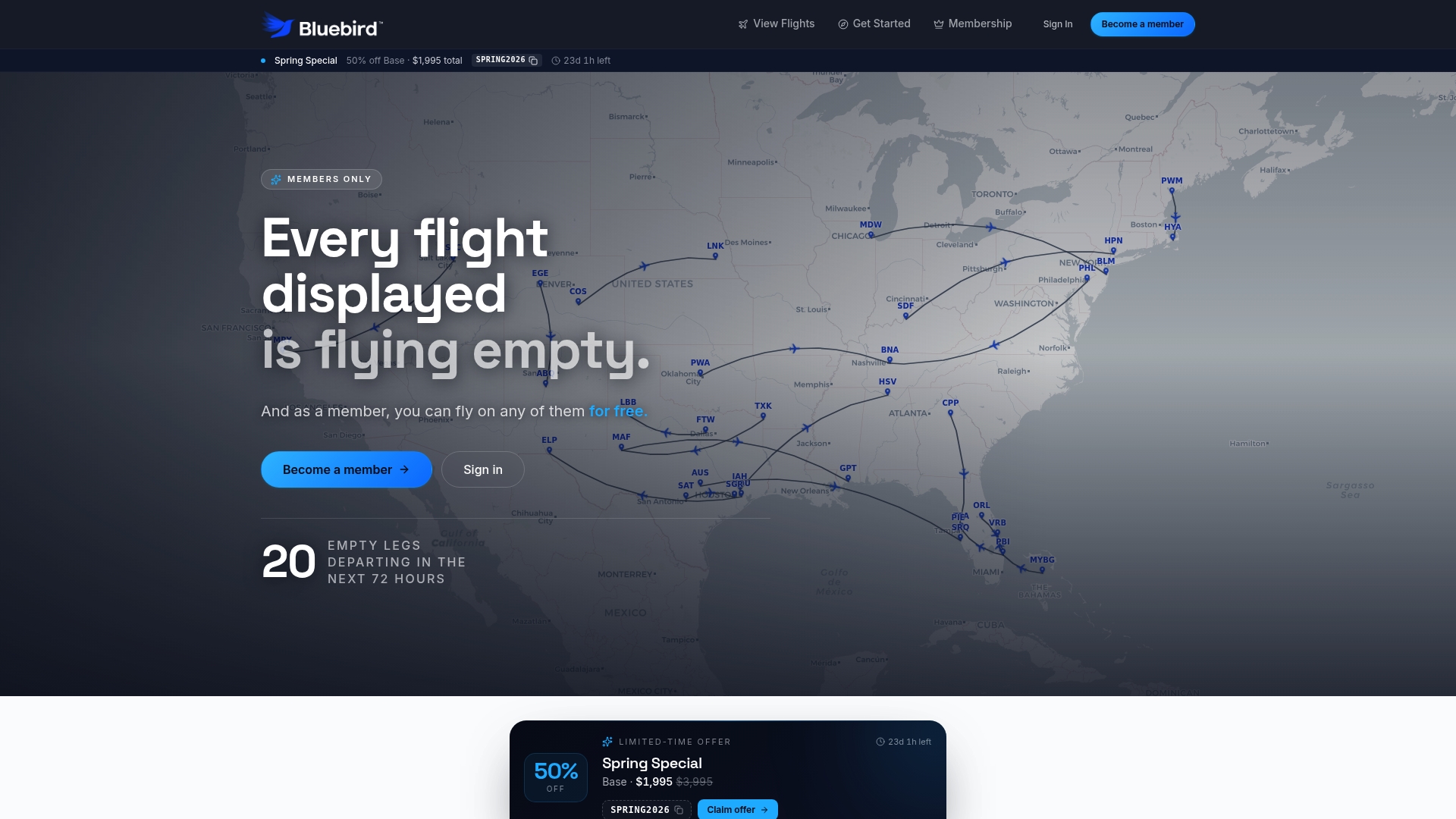
To see what is flying right now, browse the live empty-leg board. If you have a fixed date that cannot move, tell us and we will quote a custom charter separately.
FAQ
What are the blackout dates for private jets?
There is no single list. Each fixed-rate program sets its own, and they commonly center on Thanksgiving, Christmas and New Year, and in some cases Memorial Day through the Fourth of July and big sporting events. Ask any provider for its dated list for the year you plan to fly.
Can I still book a private jet on a blackout date?
Usually, yes. A blackout date generally means your program does not guarantee its fixed rate or an aircraft, not that no jet can fly. You may be able to book on-demand charter at market price, with fewer options and less flexibility.
Are blackout dates the same as peak days?
Not exactly. Blackout dates usually mean no guarantee or no standard rate. Peak days normally allow flights, but with a higher rate, longer notice or fewer aircraft choices. Some providers use the terms interchangeably, so read the definitions in the contract.
Do blackout dates apply to empty legs?
Empty legs have no fixed rate to protect, so the issue is availability. Around the busiest holidays, fewer aircraft are repositioning empty, so there are fewer flights to choose from. Flexible dates and nearby airports make the biggest difference.
How far ahead should I book for a holiday?
For Thanksgiving or the winter holidays, one published planning guide suggests four to six weeks. For empty legs, check live inventory often and be ready to move a day or two either way.
Sources
- Plan Ahead for Private Jet Peak Travel Days, SherpaReport
- 2026 Super Bowl LX special event notice, FAA
- Peak Days, CRAFT
- Book 12–15 Passenger Vans 2–3 Months Before Peak Travel, Sprinter Van Rentals