Private Jet No Show Rules: 4 Costs and How Membership Limits Risk

Private Jet No Show Rules: 4 Costs and How Membership Limits Risk
No, missing a booked private flight does not entitle you to a refund: private-jet no-show rules are governed by the operator’s contract, and missing a flight usually triggers operator fees or forfeiture of the booking payment. This differs sharply from scheduled commercial carriers, where DOT refund rules require automatic refunds for canceled or significantly changed flights. If you think you might miss a charter, call the operator immediately and get any accommodation in writing.
TL;DR:
- Contracts set cancellation windows by operator and aircraft; fees may be flat, percentage based, or full forfeiture, while empty leg bookings can follow different terms.
- Late APIS data, missing visas, or unconfirmed airport approvals can block international landing and count as cancellations initiated by passengers under most contracts.
- If a missed departure seems likely, call immediately, ask whether the contract permits a substitute passenger or rebooking, and get any accommodation in writing.
- To challenge a fee, request itemized crew, positioning, and landing costs; if the aircraft was resold or repositioned, ask in writing for a partial refund.
- A single charter can expose travelers to the full fare, while Bluebird Jets says membership turns a missed slot into a lost queue turn.
Table of Contents
- What Private Jet No-Show and Late-Cancellation Policies Cover
- Why Operators Enforce Steep No-Show Penalties
- How APIS and CBP Paperwork Affect International No-Shows
- How to Avoid a No-Show and Reduce Your Exposure
- A Membership Perspective on No-Show Risk
- Reduce Your No-Show Risk With Bluebird Jets Membership
- FAQ
- Sources
What Private Jet No-Show and Late-Cancellation Policies Cover
Operators define a no-show as failing to appear for a confirmed departure without advance notice, and a late cancellation as pulling out inside a contractually set time window that typically varies by operator and aircraft size. Both trigger fees because the aircraft, crew, and slot were already committed to your trip specifically.
Fee structures vary by operator and by how the flight was booked:
- Flat cancellation fees apply regardless of trip value, often covering administrative and positioning costs.
- Percentage-based fees scale with the quoted trip price and increase the closer you get to departure.
- Full forfeiture of the deposit or total fare applies to true no-shows with no notice at all.
- Membership empty-leg bookings often carry different terms than one-off brokered charters, since the aircraft was already repositioning for another reason.
Before you sign anything, read for the exact hour thresholds that define “late,” whether a force majeure clause excuses weather or medical emergencies, and whether the contract allows a substitute passenger instead of a flat cancellation. Brokered charters sometimes add a markup to these penalties that an owner-operated fleet does not, so the contract language is worth comparing line by line.
Why Operators Enforce Steep No-Show Penalties
A private flight is a dedicated mission, not a seat on a scheduled route, so once an aircraft and crew are assigned to your trip, most of the associated costs become fixed whether or not you show up. Operators build penalties around the real financial exposure they take on the moment they confirm your booking.
The costs that drive these fees typically include:
- Crew duty time, which is paid whether or not the trip departs, since pilots are scheduled and legally rested for your specific window.
- Positioning or repositioning costs, the expense of flying an empty aircraft to your departure airport and then elsewhere afterward; our breakdown of positioning fees explains how these add up.
- Landing, handling, and permit fees, many of which are paid or committed in advance and are non-refundable once filed.
- Lost resale opportunity, since the closer departure gets, the less likely the operator can rebook that slot to another client.
That last point explains the sliding scale most contracts use: a cancellation 10 days out costs little because the aircraft can usually be resold, while a cancellation two hours out usually means the mission is a total loss for the operator.
Pro Tip: If you plan to dispute a no-show fee, ask the operator for itemized invoices covering positioning, crew deadhead time, and landing fees, along with a timeline showing when the aircraft and crew were committed; this is the documentation operators use to justify the charge, and it is the same documentation you need to contest it.

For a sense of how these line items stack up in practice, our cost breakdown examples walk through typical crew, fuel, and fee combinations.
How APIS and CBP Paperwork Affect International No-Shows
On international trips, paperwork failures can turn into a no-show even when you intended to fly. U.S. Customs and Border Protection requires APIS manifests for private aircraft crossing U.S. borders, and operators are responsible for transmitting passenger and crew data before departure. Missing documents or a late manifest can result in denied permission to land, which most charter contracts treat as a passenger-initiated cancellation rather than an operator fault, meaning the cancellation fee still applies.
A short checklist for international private flights:
- Confirm passports and visas are valid well before the trip, since last-minute issues cannot be fixed in the air.
- Submit passenger details to the operator early so APIS transmission happens with margin to spare rather than against the clock.
- Verify arrival airport approvals, since some international airports require advance permission for private aircraft.
- Ask the operator to confirm CBP clearance was received, not just submitted, before you leave for the airport.
How to Avoid a No-Show and Reduce Your Exposure
If a miss looks likely, speed matters more than anything else. Call the operator the moment you know there is a problem, ask whether a substitute passenger is allowed under your contract, and request a rebooking window before the fee clock runs out.
A few habits reduce risk before you ever get to that point:
- Confirm APIS and travel documents early using the steps in our booking best-practices guide.
- Check guest policies in advance if you might need to swap a traveler; our guest policy guide covers what most operators allow.
- Understand that cancellation insurance has real limits: our empty-leg insurance guide explains why many policies exclude exactly the scenarios travelers expect covered, and Exotica Charters offers a useful outside perspective on when travel and cancellation insurance makes sense for chartered trips generally.
- One-off charter clients carry more exposure than members, since a single missed mission is a full financial loss rather than a forfeited slot in a larger inventory.
Pro Tip: When negotiating a reduced fee, ask the operator in writing whether the aircraft was resold or repositioned for another client; if it was, you have a reasonable basis to request a partial refund.
A Membership Perspective on No-Show Risk
Spontaneous travelers face the sharpest no-show exposure because a single missed one-off charter is a total loss. A membership model changes that math by spreading access across unlimited empty-leg flights rather than committing you to one dedicated mission. With live inventory updated daily, a queue system, and priority booking, a missed slot through our membership means picking another listed flight rather than forfeiting a five- or six-figure charter fee. Guests, up to six per flight, add flexibility without the single-passenger risk that drives steep penalties on brokered one-off bookings. For travelers who fly on short notice, that structural difference matters more than any insurance add-on.
— Nick
Reduce Your No-Show Risk With Bluebird Jets Membership
Publishing live empty-leg inventory directly means we are not reselling someone else’s slot, we are managing our own. Our membership plans give you unlimited access to that inventory, so a missed departure costs you a turn in the queue rather than a forfeited charter fee. A higher-tier membership adds higher booking priority for travelers who need first access to the most popular routes, and an optional Skip-The-Line upsell lets you move ahead in the queue for a one-off flight without changing your membership tier.
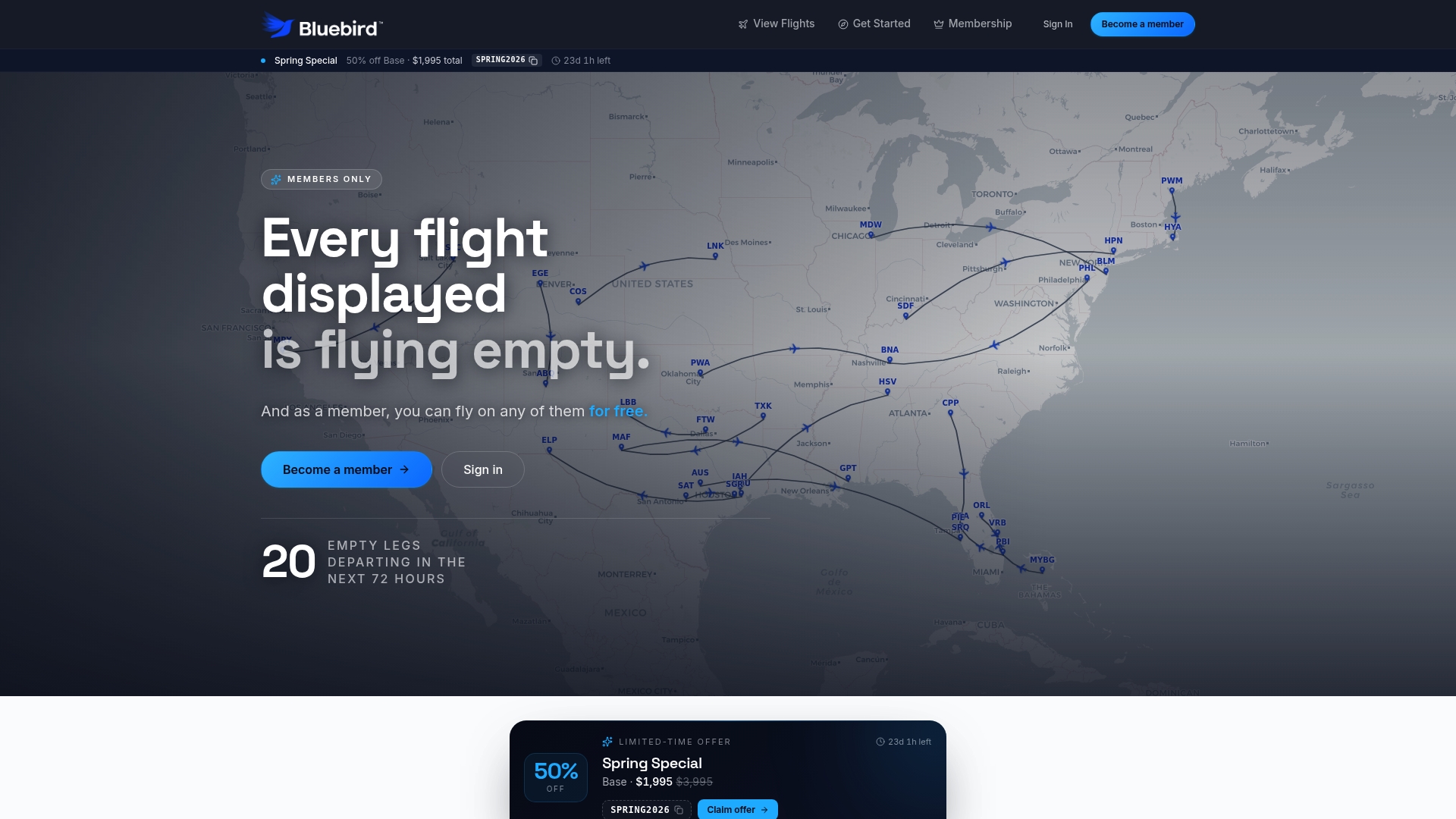
If spontaneous travel with lower no-show exposure sounds like what you need, compare Base and Plus membership details and see which fits your travel pattern, or head straight to get started and review current Skip-The-Line pricing before your next trip.
FAQ
How many hours before can we cancel a flight?
Cancellation windows are set by the operator’s contract rather than a universal rule, and the timing varies depending on aircraft type and trip length. Check your specific contract for the exact threshold, since canceling inside that window typically triggers a fee rather than a refund.
Why not wear jeans on a plane?
There is no rule against wearing jeans on a private flight, and dress codes vary entirely by operator and by the specific aircraft owner’s preferences. Most private aviation dress expectations are about comfort and courtesy to other passengers rather than any formal requirement.
Do you have to go through customs on a private plane?
Yes, international private flights still require customs clearance, and CBP requires APIS manifest data for passengers and crew on private aircraft crossing U.S. borders. Missing or late documentation can delay or deny landing permission, so confirming paperwork well ahead of departure matters as much on a private jet as on a commercial flight.
Do airlines charge for a no-show?
Scheduled commercial airlines operate under different rules than private charters, and the DOT’s final rule requires automatic refunds when airlines cancel or significantly change a flight, not when a passenger simply fails to show. Private charter no-shows are governed entirely by the operator’s own contract terms, which usually impose a fee or forfeit the booking payment.
Sources
- Biden-Harris Administration Announces Final Rule Requiring Automatic Refunds of Airline Tickets and Ancillary Service Fees | US Department of Transportation
- General Aviation Processing | U.S. Customs and Border Protection