Private Jet Name Change: What Works and What to Do

Private Jet Name Change: What Works and What to Do
A private jet name change almost always means one of two things: fixing or swapping a passenger name on a booking, or (less often) renaming an aircraft or a company. For passengers, the practical answer is to contact the operator or your concierge as early as you can, because the name on the manifest has to match the government-issued ID that person will carry. For U.S. public charters, federal rules even spell out how a substitute passenger can replace someone who cannot fly. This guide explains how it works, what to have ready, and how to avoid needing a change in the first place.
TL;DR
- A passenger name on a private flight is a security record, not a label. It has to match the traveler’s unexpired government-issued ID.
- For U.S. public charters under 14 CFR Part 380, a participant can generally get a full refund, less an administrative fee capped at $25, by providing a substitute participant.
- Unlike most airline tickets, private flights are built around a guest list that can be handled person by person, so ask early and in writing.
- Empty-leg flights are tied to a specific aircraft, route and time, so the cleanest fix for a wrong name is to report it immediately, well before departure.
- Aircraft names and company rebrands are a different topic and have no effect on your booking.
Table of Contents
- Two very different meanings of “private jet name change”
- Why the name on a private jet booking matters
- Can you change a name on a booked private flight?
- What about empty-leg flights?
- Bringing guests: where most name problems start
- A simple checklist before you send any passenger name
- What a name change should cost
- Name change, aircraft rename, rebrand: keeping them straight
- Our perspective
- Make unlimited empty-leg flying simple
- Practical timeline: when to act
- Common mistakes to avoid
- FAQ
- Sources
Two very different meanings of “private jet name change”
People type this query for three reasons, and the answers are not the same.
1. Correcting a typo or a legal name. You booked a flight for a guest and typed “Matt” instead of “Matthew,” or a surname changed after marriage and the booking still shows the old one. This is a correction, and it is the most common case.
2. Replacing one passenger with another. A colleague cannot travel, so a different person takes the seat. This is a substitution, and it is treated differently from a spelling fix.
3. Renaming an aircraft, an airport or an operator. News stories about a company rebranding or an airport being renamed turn up for this query, but they have nothing to do with your reservation. A nickname painted on a plane, or an operator adopting a new brand, does not change who is on your manifest or what ID they need.
The rest of this article is about the first two, because that is what affects someone planning a trip.

Why the name on a private jet booking matters
It is tempting to think that private aviation is looser than the airlines about identity. Some parts are more flexible: no terminal lines, no 90-minute arrival window, a short walk from car to cabin. But the passenger name is still a security data point.
Under the federal Secure Flight program, the name used for security screening has to match the name on the passenger’s unexpired government-issued ID, and it has to match the name in the reservation record used to generate the boarding document. Delta’s agency policy library summarizes this requirement for the commercial side of the industry. The principle is the same for you as a traveler: the person who shows up should be the person whose name was submitted, spelled the way their ID spells it.
In practice, that means:
- Use the full legal name as printed on the driver’s license or passport the guest will carry that day.
- Do not use nicknames, shortened first names or a married name the ID does not yet show.
- Check middle names or initials if your operator asks for them.
- Confirm that the ID is unexpired before you send the name.
A mismatch is not a catastrophe if it is caught early. It becomes a problem when it is discovered at the aircraft door.
Can you change a name on a booked private flight?
Usually yes in some form, but the route depends on what kind of change you need and how close you are to departure.
Fixing a typo or spelling
A correction does not change who is flying. It changes how the same person is recorded. Because the traveler is the same, this is typically the easiest request to resolve. Send the operator or your booking contact:
- Your reservation or flight reference.
- The name as it is currently recorded.
- The name exactly as it appears on the guest’s ID.
- A clear photo of the ID page, if the operator asks for it through a secure channel.
Do it as soon as you notice, not on the morning of the flight.
Swapping one passenger for another
This is a substitution, and there is useful federal language about it. For U.S. public charters governed by 14 CFR Part 380, the regulation requires operator-participant contracts to state that refunds are limited when a participant changes plans, and to specify the terms for participant substitution. According to the text of 14 CFR §380.32, a participant who wishes to cancel may receive a full refund, less an administrative fee capped at $25, upon providing a substitute participant. The same section says the refund is due within 14 days after the cancellation or substitution.
Two points to take from that:
- Substitution is a recognized, regulated concept in U.S. private flying, not an exception that requires special pleading.
- The fee on that route is capped, so a substitution under those rules is not supposed to be a profit center for the operator.
Not every private flight is a Part 380 public charter, and your own agreement controls your particular booking. Treat the rule as a useful benchmark for what is reasonable, and read your operator’s terms for what actually applies to you.
Why airline habits do not carry over
Commercial ticketing is far more rigid. Travelport’s guidance on changing passenger names notes that most carriers do not permit name changes after a ticket has been issued and that procedures vary by carrier. Its workflow tells agents to confirm the carrier’s own procedure, get authorization where it is required, and then update the booking record to match.
Private aviation works around a small cabin and a defined guest list, so the conversation is usually more personal. You are not fighting a fare rule built for 180 seats. You are asking a team that knows the aircraft, the crew and the manifest to update one line. That still needs the same discipline: the change must be authorized by the operator and reflected in the passenger record before departure.
What about empty-leg flights?
Empty legs are repositioning flights: the aircraft has to get from one airport to another anyway, so seats are offered on a route and time the operator already needs. That has a few consequences for name changes.
- The schedule is set by the aircraft, not by you. A name change does not alter the route or departure window, so it is usually a manifest question rather than a rebooking question.
- Timing matters more. Routes can shift because the aircraft’s own plans shift, which is why it is wise to settle the guest list early. Our guide on avoiding a lost empty leg when routes change explains how to stay flexible.
- Cancellation and substitution terms are specific to the operator. Our overview of FAA rules, memberships and empty leg cancellations walks through what to expect.
If a name is wrong on an empty-leg reservation, the best move is the simplest one: tell your booking contact right away, give the exact ID spelling, and ask them to confirm the corrected manifest back to you in writing.
Bringing guests: where most name problems start
Most name issues on private flights do not involve the member. They involve a guest added at the last minute by text message. A first name goes in, the surname is guessed, and nobody checks the spelling until the day of the flight.
A few habits prevent nearly all of it:
- Ask each guest to send you a photo of their ID name line, or to type their legal name themselves.
- Collect names for the whole group at once, not one at a time over several days.
- Confirm minors’ names and ages. Our piece on private jet age requirements for empty leg members covers what to prepare.
- Read the private jet guest policy before you invite a full cabin.
For pets, smoking exceptions and other special requests, the same principle applies: tell the team before the trip, not at the aircraft. See our notes on private jet pet travel and smoking exceptions.
A simple checklist before you send any passenger name
Use this list every time, whether you are booking one seat or a full group.
- Legal name as printed on ID. First, middle if requested, last.
- ID type and expiry. Make sure it is unexpired on the travel date.
- Date of birth, if asked. Same source as the ID.
- Contact number for each adult. So the crew can reach them on the day.
- Written confirmation. Ask for the final manifest to be read back to you.
- A calendar reminder. Set it for 48 hours before departure to re-check names.
That last step is dull, and it saves more trips than any other.
What a name change should cost
The honest answer is: it depends on the operator’s terms and on whether it is a correction or a substitution. A pure spelling correction is an administrative edit. For a substitution on a U.S. public charter, the federal benchmark is a full refund less an administrative fee capped at $25 when you provide a substitute, as described in 14 CFR §380.32.
What tends to cost real money is not the edit but the surrounding change: a new departure time, a different airport or a custom charter. Custom charters are quoted separately, and our guide on custom charter quotes shows how to read them so there are no surprises. Fuel can also move a quote; see how fuel surcharges add up.
Name change, aircraft rename, rebrand: keeping them straight
If your search was prompted by headlines, here is the short version.
| What changed | Does it affect your booking? | What to do |
|---|---|---|
| A passenger’s name is misspelled | Yes | Report it immediately with the exact ID spelling |
| A different person will fly | Yes | Ask about substitution terms in writing |
| An operator rebrands | Not your passenger record | Keep your confirmation and contact details current |
| An aircraft has a nickname or is renamed | No | Nothing needed |
| An airport is renamed | No, the airport code is what matters | Check the code on your itinerary |
The common thread: only changes to who is flying (or when and where) touch your reservation.
Our perspective
Most name-change stress is self-inflicted, and almost all of it can be avoided before the flight is ever booked. When you fly empty legs, you are choosing flexibility: you pick up a seat on a route that is already happening. The smart way to use that is to be just as flexible about your paperwork. Collect legal names early, keep them in one note, and send them together.
We operate our own Learjet 60 aircraft and publish live empty-leg inventory with no broker markups, so when a guest list needs attention, you are talking to the team that actually runs the flight, not a chain of middlemen. Members can bring up to six guests, and that is exactly where name accuracy matters most. Our concierge support exists so that a quick fix is a short conversation, not an ordeal.
Our advice is simple: treat the guest list like a boarding pass. Check it twice, and check it early.
Nick
Make unlimited empty-leg flying simple
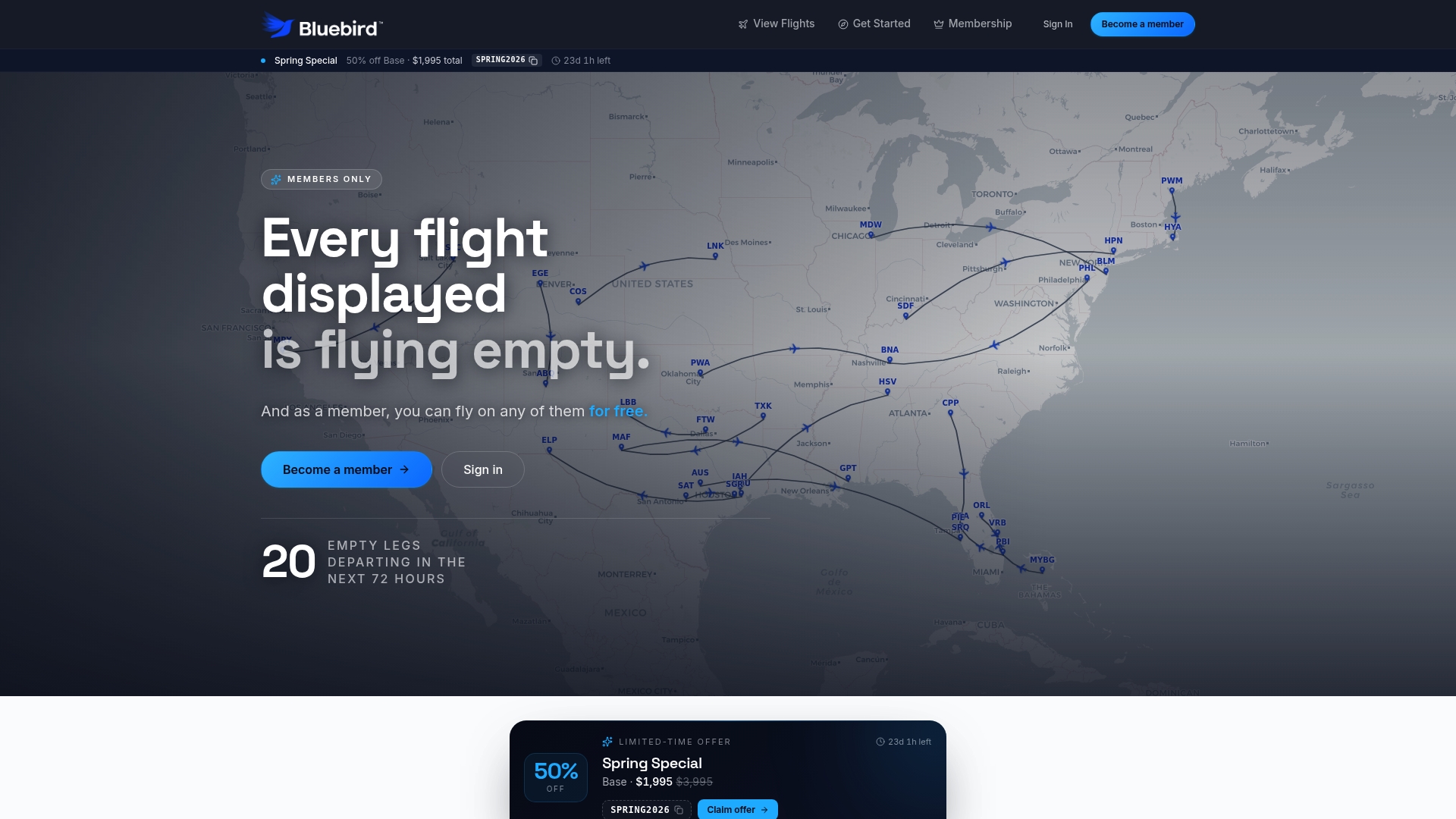
If you fly often enough that managing guest lists and last-minute plans is part of your routine, a membership removes a lot of friction. Bluebird’s annual membership gives you unlimited access to published empty-leg flights on our Learjet 60 aircraft, with live inventory updated daily. The Base plan is $3,995 per year and Plus, with higher priority, is $9,995 per year. Skip-The-Line is a $2,000 one-off fee for when you want to move ahead in the queue. You can compare both plans on the membership page and see current routes on our flights page.
Before you commit, read our notes on booking best practices and on how to cancel a membership before renewal, so you know exactly how the year will run.
Practical timeline: when to act
Timing is the quiet variable behind every successful name fix.
As soon as you book. Send names from ID, not memory. Ask for the manifest back in writing.
A week before. If a guest’s plans are uncertain, say so now. Substitution is easier with time on your side, and the federal framework for public charters is built around giving the operator a substitute participant.
Two days before. Re-check every name and ID expiry date. This is the moment to catch a passport that expires next month or a nickname that slipped in.
Day of departure. Everyone carries the same ID used for the booking. Keep digital copies as a backup, but do not rely on them in place of the original.
Common mistakes to avoid
- Booking under a nickname. “Bob” is not “Robert” to a security system.
- Assuming a marriage certificate is enough. The ID is what is checked. If it still shows the former surname, use that.
- Adding names one by one. It invites inconsistent spelling. Send them in one message.
- Waiting for the airport. Correcting a name at the aircraft door is the hardest time to do it.
- Confusing a rebrand with a record change. A company or aircraft name has no effect on who is on your manifest.
FAQ
Can I change the name on a private jet flight I already booked?
Usually you can correct or replace a passenger, but the terms depend on the operator and how close you are to departure. For U.S. public charters, federal rules on participant substitution set a benchmark: a full refund less an administrative fee capped at $25 when a substitute is provided. Ask your booking contact early and request written confirmation of the updated manifest.
How much does it cost to change a name on a private flight?
A simple spelling correction is typically an administrative edit. A substitution on a U.S. public charter carries an administrative fee capped at $25 under 14 CFR §380.32. Your own agreement governs your booking, so confirm the specific terms before you pay.
What ID must match the name on the booking?
The name should match the passenger’s unexpired government-issued ID, such as a driver’s license or passport. That mirrors the Secure Flight standard used across U.S. aviation. Use the legal name exactly as printed, not a nickname or a name the ID does not yet show.
Does renaming an aircraft or operator affect my reservation?
No. An aircraft nickname, an operator rebrand or an airport renaming does not change your passenger record. Only changes to who is flying, or when and where the flight departs, require action on your booking.
Can I bring guests on an empty-leg flight and name them later?
It is better to supply every guest’s legal name when you book, because the manifest needs to be accurate before departure. If a guest is still unconfirmed, tell your concierge so the team can plan for a swap. Members can bring up to six guests per flight.
Sources
- 14 CFR §380.32, Specific requirements for operator-participant contracts
- Travelport, Changing Passenger Names
- Secure Flight Passenger Data Program FAQs